About Dale

Journalist in the Canadian Parliamentary Press Gallery

Bruce Hyer and his contradictory “solutions” for democracy

Last week newly independent MP Bruce Hyer took to the blog rolls of the Huffington Post to talk about what he sees as the ills of our democracy while giving a partial explanation for why he left the NDP – and that mostly amounts to party discipline. Nobody is denying that excessive party discipline is a problem with our system at present, but simply saying all party discipline is bad is reductive and doesn’t give proper consideration to its proper role within the Westminster system.

As a quick refresher, party discipline exists because a government needs to command the confidence of the House of Commons, and when matters of confidence are put before the Chamber, they crack the whip to ensure the survival of the government. It is also used along with brokerage politics to keep individual MPs from demanding that governments give special considerations for their ridings in exchange for their votes. Observe the number of “bridges to nowhere” that happen in systems where there is almost no party discipline. Obviously the legitimate uses for discipline have been increasingly abused on both sides, and We The Media don’t help when we suddenly start salivating at the prospect of internal division within a party. Nevertheless, it does exist for a valid reason that needs to be acknowledged before one can denounce the concept in its entirety.

Continue reading →

Roundup: Just take the minister’s word

While the issue of missing regulations on EI changes dominates the debate in the Commons right now, it seems that department of Human Resources and Skills Development did conduct a focus group study on what it would take to encourage people from high-unemployment areas to those regions with better opportunities. The minister has tried to distance herself from this study and her comments have consistently been about finding work within one’s region, but without any regulations on offer, we are left to take her word for it.

Seeing as political parties and voter databases exist outside of privacy legislation in this country, you would expect that this might lead to problems. Well indeed it has, with the voters’ list being abused with fraudulent robo-calls, and people being added to databases after contacting their MPs on policy concerns or case files. Who would have guessed?

Continue reading →

PO2 James Anthony Leith on his military decorations

As part of my story on the new Canadian Honours exhibition at 90 Wellington, I spoke to another of the attendees, Petty Officer 2nd Class James Anthony Leith, MMM, SC, MSM, CD, one of the most decorated members of the Canadian Forces – who, I will add, is one of the most humble and charming people I have ever interviewed. As I couldn’t get much of the interview in the story, I’m posting the whole thing here.

Q: Briefly, tell me what your decorations and medals are.

A: You never get these things by yourself – somebody always nominates you. They tell the stories that they shouldn’t have told to somebody else, and it gets passed up. I was gracious enough to know some big mouths. The one on the far left is the Canadian Forces Decoration, and you get that after twelve years of undetected crime – basically you’re a good boy. Next to that is my General Service Star for Afghanistan. I was fortunate enough to be invited to participate with the Army…in 06/07. Next one is the SWASM – South-West Asia [Service Medal] – it’s a theatre medal. Everyone who goes over there gets one, and it’s like being in the Boy Scouts – you get one if you go. The next one is a sacrifice medal – in 2006, I was in an armed personnel carrier that got obliterated by an IED, so there’s a bunch of us that got kind of injured from it, and we don’t have the wound stripe like the Americans do, so they commemorate it with a sacrifice medal. Everyone who theoretically bled on the battlefield gets one of those. Next to that is the Meritorious Service Medal – again, wrong place right time or right place wrong time. I was working in Halifax as a commercial diver as part of the fleet diving in the Atlantic, and Swiss Air 111 pitched and went into the sea. They immediately called us because of the depth, and we participated in the recovery because of the depth operation, and for that they gave us that little one. The next one is the Star of Courage – I was in Afghanistan in 06, and after we got blown up, we found some other nasties that the other team had put in the ground. All of my tools that had been in the first vehicles were destroyed, and that’s the story that everybody loves hearing. I basically MacGyvered the second IED with what I had left, which was my bayonet. Because I’d just been blown up […] and not have any of the proper equipment that I’m supposed to have, and the fact that I took apart that second one, somebody said that was either very brave or very dumb. Everybody loves a good story, and somebody told somebody else, and I was invited up here again to get this one. And next to that is the MMM – the Order of Military Merit. Because I have 20-odd years of service, and pretty well been a good boy for all that time, at a certain point in your career, after a long career spanning a lot of service, they nominate you, it goes before a committee and they sit down and figure out who gets what, and are they truly deserving, but again I don’t know who nominated me, but somebody put my name up there and wrote a very nice, lengthy, long-winded paragraph, and I’m sure they hummed and hawed, and it must have been the end of the day, and they said give it to the guy anyway.

Continue reading →

Dr. Jolly on her Order of Canada honour

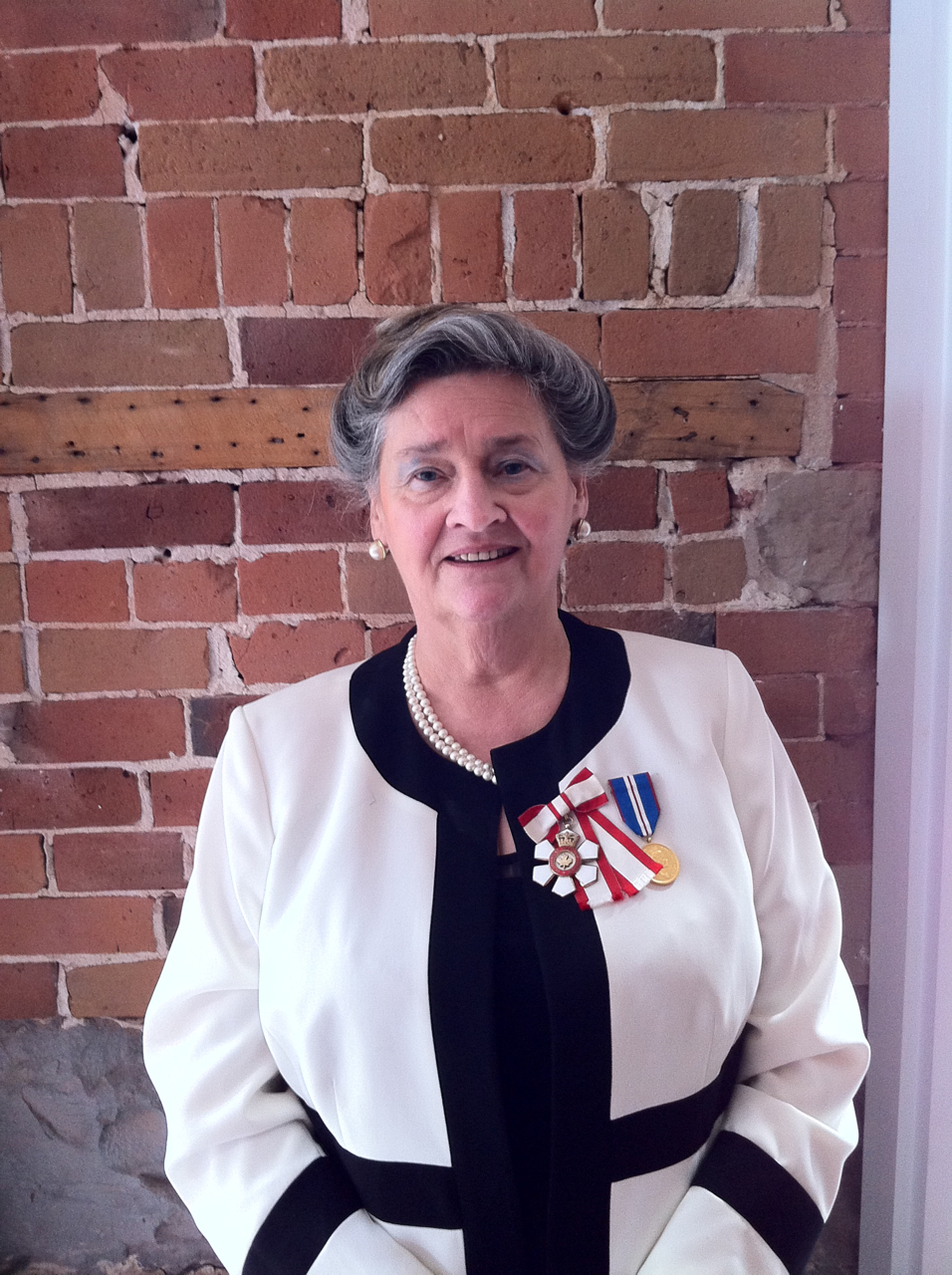
As part of my story on the new Canadian Honours exhibition at 90 Wellington, I spoke to one of the attendees, Dr. Elaine Jolly, the Founder of the Shirley E. Greenberg Women’s Health Centre, and recipient of the Order of Canada and the Queen’s Golden Jubilee Medal. I couldn’t get much of my interview in the story, but I figured I’d put the whole thing here.

Q: Tell me about your story.

A: Well, I’m an obstetrician and gynaecologist, and presently I’m the medical director of the women’s health centre at the Ottawa Hospital. I was very honoured and privileged to receive the Order of Canada in 1999, and was notified in 1998. It was for the activities that I had undertaken for women’s health, and as an academic – because I’m a professor at the University of Ottawa – I have had extensive experience with education and public education, and education of students and residents, and our own continuing medical education for physicians. With regards to accomplishments, I must say that when I got the Order of Canada, I was very overwhelmed because I didn’t think that I was doing anything terribly special that many other academics had done, but having a focus on women’s health – and at that time, I was obviously nominated and supported for this – they deemed that that was a good thing. What it did do, however, was spur me on to really fulfil things that I would have liked to have done, and I think it probably helped, and that’s the development of the Shirley E. Greenberg Women’s Health Centre. In Ottawa, I formed a women’s health council, because having a women’s health centre fell on deaf ears in the Ottawa hospital system. Not because it’s not a good thing, but because there were many other priorities, and women’s health is not one of them. It’s really not a priority still for the provincial government. If you have cancer, and that’s important, and if you have orthopaedic things like hip replacements and cataract surgery that’s good, and there’s nothing wrong with that, but we still have to really work hard to get the issues related to women’s health and obstetrics and looking after women who are pregnant seems to be a little more appreciated, but looking after women and their health, promotion of health, prevention of disease, looking at the number one issue that women have mortality with is cardio-vascular disease, and how does it differ from men’s health, because it is different – women don’t have that sudden, horrible chest pain – they have atypical symptoms. So looking at that, and osteoporosis, and cancers that women have, the number one cancer killer believe it or not is not breast cancer but lung cancer, so smoking cessation is pretty important. Looking at diagnosis and early management of breast cancer is important, and looking at the global picture for women’s health, and as a gynaecologist, I look at problems with women’s reproduction. At the Women’s Health Centre, we have a multidisciplinary group, but mainly gynaecologists looking at those areas that fit in. We have 30 gynaecologists, we see 30,000 women a year, we opened in 2005 – Shirley Greenberg was instrumental in giving us a lot of money, which we also raised to not totally match, but we came close to it. And then the government was sort of pushed into supporting us, and the hospital was pushed into supporting us because the women’s voices were heard, and I have to tell you that the women here in Ottawa and in Eastern Ontario are responsible, along with Shirley for improving women’s health. Being a catalyst for that sort of thing, along with my daily duties, it was a good thing. My story is pretty simple, but I’m very proud of what we’ve accomplished.

Continue reading →

QP: Increasingly angry tangents

I’m not going to lie – it was a pretty ugly day in the Commons today. Harper wasn’t there, and everyone was in a pretty snappish mood already, after a morning full of committee shenanigans. When Thomas Mulcair started off by asking about the government getting the RCMP to launch a probe into the Globe and Mail after a story about the F-35s, James Moore – the back-up PM du jour – started off with a perfunctory “We have a responsibility to protect sensitive information,” before turning to Mulcair’s comments about the resource sector and mischaracterising those quotes as calling them a “disease” (which is not what “Dutch disease” refers to). But then Mulcair would go on a tirade defending his comments, before returning to his completely unrelated RCMP probe questions. And Moore would answer back with an attack, and Mulcair’s tirades would get increasingly angry and tangential, until he went on about the government following the development model of “Nigeria and not Norway” in a rant that was clearly not a question – not that it mattered by that point. Bob Rae toned things down a bit asking about the Canadian Federation of Independent Business’ comments about the changes to EI, and Moore, calmly, told him the changes were in the legislation. Which of course, they aren’t – the changes are dependent upon future regulation – but Rae did not lose his cool, though he did get a bit more excited on his final question – about the missing numbers of how much the OAS changes would save the treasury, but Moore simply repeated the boilerplate talking points about changes not coming until 2023.

Continue reading →

Roundup: Complicating the “Dutch disease”

Western premiers continue to strike back at Thomas Mulcair, refuting his assertion that they are simply “Harper’s messengers,” while he sticks to his guns on the “Dutch disease” diagnosis, calling it “irrefutable.” Erm, except more economic data shows that it’s not. An IRPP study shows that while there may have been a mild case of said “disease,” it’s a far more complex picture than simply Alberta versus Ontario’s manufacturing sector, as the decline in the manufacturing sector has more to do with the rise of China than it does with the strength of our dollar, which has in turn helped other sectors of the economy as well. Meanwhile, Statistics Canada reports that the manufacturing sector is rebounding. Not that we should expect Mulcair to back down from his position anytime soon.

It seems that the F-35s were built with no cybersecurity protections in them, making them as vulnerable to cyberattacks as Humvees were to roadside bombs, apparently. But these are still the best aircraft that our airmen and women need, remember! Meanwhile, the government sent the RCMP on a five-month probe into what they thought might have been leaked documents after a Globe and Mail story on the F-35s, which turned out to be nothing. Well, nothing but a warning that if the government doesn’t like what the media is reporting, they’ll read too much power into certain National Security Acts that don’t really apply and send the RCMP after them.

Continue reading →

QP: Tinfoil hats and telecom trouble

While some MPs may have been a bit bleary-eyed from the previous late night, it certainly didn’t make for a dull Question Period. Or perhaps, that’s why it took such a turn for the worse the longer it continued. Thomas Mulcair was up first, reciting his carefully prepared questions on why the government still hadn’t provided any figures for the planned changes to OAS, to which Harper assured him that there weren’t going to be any actual cuts to benefits. Mulcair then turned to the issue of Chinese telecom company Huawei being granted Canadian contracts after the US and Austraila barred them as security risks. Harper insisted that the US doesn’t dictate our policies. When Randall Garrison rose to keep asking about the same questions, Vic Toews said that the CBC story only told half the tale, and that his officials weren’t in opposition, while Conservative backbenchers chirped about people wearing tinfoil hats. Bob Rae got up to ask about the changes to EI and how worker protections were eroding as their rights would no longer be enshrined in legislation, but rather in regulation. But when he demanded that Harper produce said regulation now, Harper dodged and insisted that the appeals process would remain in place. When Rae turned to the issue that the government wouldn’t produce the data on how much would be saved in the OAS changes, Harper reminded him that the measures wouldn’t be coming into effect until 2023.

Continue reading →

Roundup: Scrutiny versus populist outrage

The government is backing another private members’ bill, this time about establishing a mandatory minimum sentence on kidnapping a person under 16 – despite the fact that a former Supreme Court justice calls this unnecessary and creating a more patchwork Criminal Code that increasingly is ad hoc and full of loopholes and inconsistencies. It’s like the government were going along with anything that sounded good without giving it proper thought or analysis. Oh, wait –that’s exactly what they’re doing. Who needs proper scrutiny when you’ve got populist outrage on your side?

Thomas Mulcair dismisses the premiers of Alberta, BC and Saskatchewan as “Harper’s messengers” when they go after him about his comments on the oil sands and our supposed “petro dollar.” Erm, okay. Because that makes sense. Paul Wells further dissects that particular line of thinking here.

Continue reading →

Lord and Smith Commission, Episode 6

My friend Destine Lord and I have a new video up, in which we talk about the opposition strategy around the omnibus budget bill, and Thomas Mulcair’s “Dutch disease” comments.

QP: Orwell was not a how-to manual

With the NDP now out to turn public opinion to their side on the omnibus budget bill, one wondered if this was going to lead off QP for the day. And in a sort of tangential sense it did, as Thomas Mulcair asked about Jim Flaherty’s comments that OAS changes could save $10 to $12 billion. Harper insisted there would be no actual pension reductions. Mulcair then turned to Flaherty’s “there are no bad jobs” comments with regards to EI changes – and several times was drowned out by Conservative applause when he repeated Flaherty’s statement. (And yet he kept repeating it and kept getting drowned out). After a warning from the Speaker, Mulcair finished and between that and two follow-up questions about how that also applied to seniors and the disabled, Harper insisted that Canada has a superior job creation record, and hey, they have a disabled member in the cabinet, so there’s nothing that disabled people can’t do. Bob Rae was up next, and brought up George Orwell’s Nineteen Eighty-Four and how it shouldn’t be a how-to manual for governments, and he related this to the kind of silencing of critics the government has been engaged in, whether it is with the National Round Table on Environment and the Economy, or any other number of NGOs or data-gathering organisations. Harper insisted that they were interested in administrative savings and doing away with duplication where the information these groups provide could be found elsewhere. For his final supplemental, Rae gave a nod to the Auditor General’s return to the Public Accounts committee and his assertion that the government wasn’t giving accurate numbers on the F-35s. Harper turned to his rote talking points about no contracts signed and no purchase having been made, and left it at that.

Continue reading →