About Dale

Journalist in the Canadian Parliamentary Press Gallery

Decrying MacKay’s “sad spectacle”

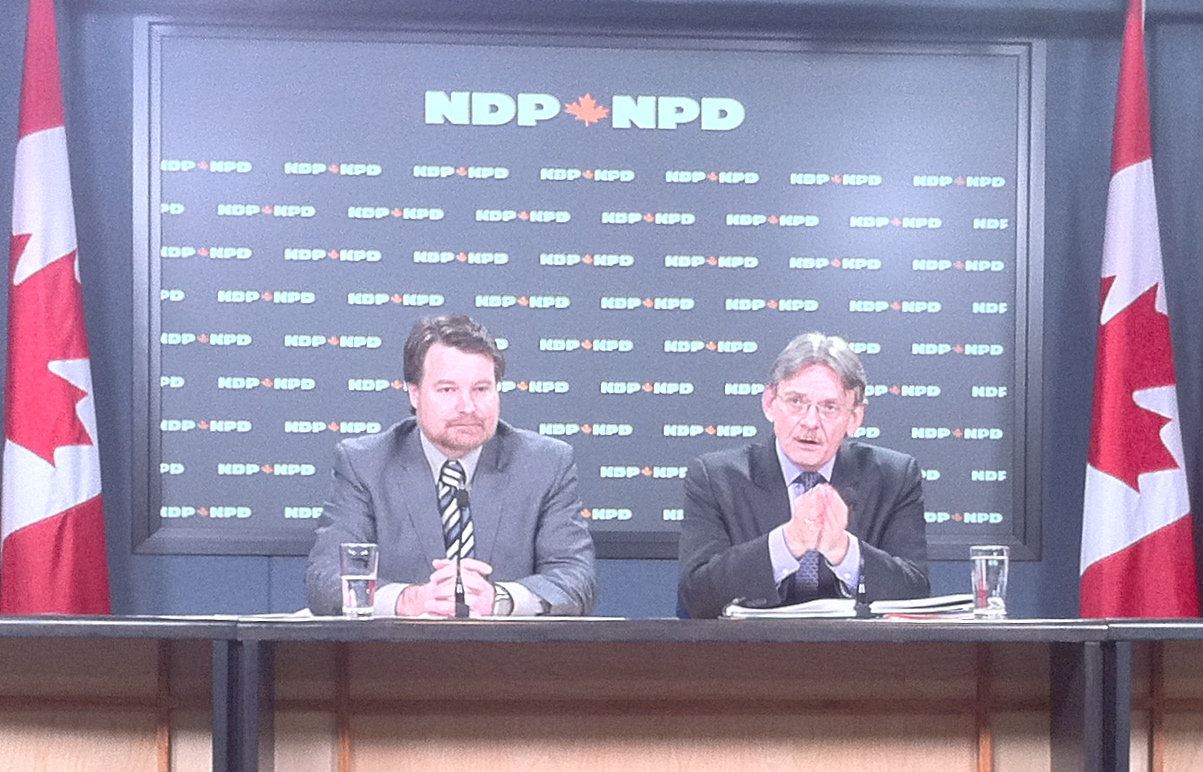
It was the NDP’s turn to talk about the F-35 process, and their defence critic, David Christopherson, and public works critic, Matthew Ravignat, who presented themselves at the National Press Theatre to discuss the situation. Christopherson started off saying that while MacKay had assured the press that the F-35s were the best value, we can never know that since there was never a competitive bid or tendering process. He then veered off to talk about the submarine programme, and decried how MacKay said yesterday that all four subs would be in the water by 2013, and yet responded to an Order Paper question weeks ago saying that the HMCS Cornerbrook will be in drydock until at least 2016, never mind the fact that we don’t have enough trained crews to maintain operational readiness.

Ravignat, however, had somewhat harsher words for MacKay.

Continue reading →

Calling out an incompetent minister

In the first of two opposition press conferences on the F-35 procurement today, the Liberals were up first, with both Marc Garneau and John McKay to discuss “accounting versus accountability” with the process, in light not only of the Auditor General’s report, but the government’s defending the differences as being “a difference in accounting.”  The intention had been for Bob Rae to join in by Skype, but this was prevented due to technical issues, some of which were the difficulty in shooting him on the screen behind the two MPs. Nevertheless, Garneau and McKay held their own, as Garneau launched into the Conservative government, saying that they had lied to Canadians about holding an open competition, and then lied to them on the escalating costs.

“There was nothing open and transparent about the way the Conservatives handled the procurement process,” Garneau said.

Continue reading →

Roundup: Branding Mulcair

The NDP have launched their English-language ads about Thomas Mulcair, which is mostly a bunch of b-roll people saying how great Thomas Mulcair is, at which point Olivia Chow says that Layton’s vision is in good hands, and Mulcair gives his pledge to “get the job done.” And hey, the party has been buying up some prime ad space too. Mind you, it seems these scripts were done up before the leader was even chosen, but considering how much in “violent agreement” they all were about policy it wouldn’t have affected the outcome much one way or the other.

Good news, everyone! Peter MacKay promises there will be more transparency with the F-35 going forward. Great. Now what about a proper procurement process that isn’t rigged and predetermined? Maybe? No answer. Meanwhile, Laurie Hawn seems to think that the Auditor General doesn’t know how to do his job, while Peter MacKay seems put out that DND will have to actually calculate operational lifetime costs as part of procurement – you know, like Auditors General have been asking for, for years now. The poor little lamb. Oh, and former Assistant Deputy Minister Alan Williams? Is still not buying any of these accounting excuses, for the record.

Another of our submarines is (finally) ready for sea trials, making that two now in the water. Meanwhile, it seems the navy may have some training issues with crews for said submarines, which really can’t be a surprise given how long they’ve been in drydock.

It appears that Canada will be setting up a separate immigration system for skilled tradespeople to deal with all of those labour shortages in places like Alberta.

Here is an accounting of how John Baird picked up the phone eight times to “lobby hard” against a vote for recognition of Palestinian statehood at the UN.

Just like the Manning Centre does for the Conservatives, the nascent Broadbent Institute has a poll that shockingly supports the NDP’s partisan position. I know – I’m just as surprised as you are.

Here’s a glance at the thirteen Senate “hopefuls” in Alberta’s “nominee election.” Note how they’re running under provincial banners for seats in federal caucuses – because that totally makes sense.

Here is a look at just what those cuts coming to the CBC will be, including the closure of foreign bureaux and the cancellation of two current affairs shows.

And one of Michael Ignatieff’s old novels, Scar Tissue, is being given new life as a theatre production in Vancouver.

Roundup: Distortions and unfollowed guidelines

An American expert following the F-35 debacle asserts that the government’s response doesn’t go far enough. You don’t say! And that General Natynczyk still thinks they’re the best jet for our air force, no matter what anyone says? Get out of town! Meanwhile, here are some of the references around how this was or was not just an “accounting error,” the lifecycle being assessed – which former Assistant Deputy Minister Alan Williams calls “a distortion” – and while Peter MacKay assures us that there’s all kinds of documentation to back this up, the Auditor General repeatedly said there was not. And Andrew Coyne goes to Treasury Board guidelines to take apart MacKay’s argument.

It cost the public purse $2.3 million for Elections Canada to investigate and take the Conservatives to court over the In & Out affair, for which they paid out a meagre $52,000 in fines.

Here’s a good examination of the meaning of the government’s decision to dismantle the National Roundtable on Energy and the Economy, and the negligible savings to the treasury that will actually result.

The government has also cut all funding to the National Aboriginal Health Association, which will close in June.

Also, cuts to the Canadian Space Agency will likely impact on future projects that Canada will be able to participate in.

Hat tip to Aaron Wherry for finding the speech by John Diefenbaker in 1949 about the role of the Official Opposition, and how they were having the very same doubts about the estimates process and the role of the Public Accounts Committee back then as they are now.

So many communities tried to host a Diamond Jubilee party that the special fund has been “oversubscribed.”

And the NCC is going to start putting up plaques with the statues of the Fathers of Confederation and early prime ministers up on Parliament Hill, so that people know who they actually are and what they accomplished. Which really is long overdue, really.

Roundup: Just a difference in accounting

Peter MacKay says that we don’t have to worry – that extra $10 billion figure with the F-35s was all just a difference in accounting about what was included in those figures, such as salaries and fuel, and so on. Which seems a bit…dubious, especially seeing as this is the first time they’ve said anything like that, and went on the attack against people like the Parliamentary Budget Officer when his numbers were released a while back that are closer to the $25 billion figure. So clearly, if it was a difference of accounting, they would have said that a year ago, and they didn’t. Even if MacKay’s assertion is true, and I have doubts, it does not excuse the rigged process either, which also needs to be repeatedly called out as well. Meanwhile, here are a bunch of quotes about the F-35 process in the past.

Despite the third party manager being withdrawn, the chief of Attawapiskat is pressing ahead with her court challenges as to what all went down.

Oh noes! BC is delaying their bill to hold Senate “consultative elections” because the private member’s bill proposing them “needs more work.” Not only is it a dumb idea to start monkeying with federal constitutional issues at a provincial level, but doing so in order to try and win some political favour is equally nonsensical, and with any luck this inane idea will die a death by fire.

Here’s a really awful tale about what a family was put through when a young soldier committed suicide.

And here’s a look at the meaning of Thomas Mulcair’s beard. No, seriously. Also, a look at his wife and political confidante.

Roundup: How to run a procurement process

On the F-35 file, former Assistant Deputy Minister of procurement at DND, Alan Williams, has a few criticisms of his own of the Auditor General’s report – that it wasn’t nearly scathing enough – that the process that Harper is putting into place is just making things worse, and walks us through the steps of a properly run process to purchase fighter jets, and how the process to replace the CF-18s should be revamped from top to bottom. It’s a must-read on the entire debacle.

Meanwhile back at DND, there are more problems with the procurement processes for upgrading our frigates and maritime patrol planes. This doesn’t bode well for the state of oversight within the department.

In the event you haven’t seen them yet, the NDP have put out ads to start branding Thomas Mulcair’s image, with the rolled sleeves and all. They’re trying to do this before the Conservatives start their own ads, and while Rae is giving him a public beating over turning into a “Mini-Harper.”

Despite what has been speculated after Rae’s big fiery speech on Wednesday, he’s still not running to be permanent leader. At least not yet anyway. And no, Justin Trudeau isn’t running either.

Here’s a look at some of the hidden “back office” costs when it comes to imposing new efficiencies in public service departments in order to enable the staffing reductions. Hint: Efficiencies don’t come for free.

The Governor General is off to France to participate in ceremonies marking the 95th anniversary of the Battle of Vimy Ridge, which was a defining moment in our history.

And Susan Delacourt muses about the Twitter vs. Tim Hortons “schism” that Charlie Angus alluded to in his big tirade while leaving the Twitter Machine. It seems to Delacourt that regardless of the venue, the value is in listening and interaction.

Roundup: The AG’s latest explosive revelation

Speaking to the media yesterday morning, the Auditor General confirmed that the government would have known about the more accurate $25 billion price tag for the F-35s before the last election, based on the documents at DND that he saw. Which is a pretty big deal, considering it calls into question everything that Harper has been saying not only during, but since the last election. In fact, Bob Rae was so outraged that he is moving a motion of privilege in the House of Commons, saying that it is a fundamental right for Parliament to be told the truth, and if the government deliberately misled the House, then there must be consequences. Oh, and the PMO? Put out a release that tries to “clarify” their numbers, saying the previous figure didn’t include a bunch of numbers that the Parliamentary Budget Officer’s did, which sounds a bit rich at this point.

Here is another attempted explanation as to what and was not a “contract” or a Memorandum of Understanding with regards to the F-35 purchase, and how that added to the confusion. Here’s a look at how DND bullied other departments into signing on by using threats of the loss of industrial benefits. Brian Stewart muses about how this debacle fits into the “culture of secrecy” in the government.

NDP leader Thomas Mulcair gave a speech at the Economic Club of Canada to show that the NDP can be sound fiscal managers, and to talk about how he’s not opposed to the oil sands per se, just the way in which they’re being developed.

A Quebec judge has put an injunction on scrapping any long-gun registry data from Quebec.

Attawapiskat will no longer be under third party management, ostensibly for because conditions have improved there, but some – like Charlie Angus – believe it’s because the government is covering its tracks for blowing the file.

Here’s a look at the effect the closure of Rights & Democracy is going to have on places like Burma, where the agency was doing good work.

And here are five things you need to know about public service job cuts.

Trans bill gets new life in the Commons

It may not be entirely history repeating, but for the second time, the bill to codify the rights of transgendered and transsexual Canadians reached the House of Commons. In its previous incarnation in the previous parliament, it made it through the House of Commons and over to the Senate, however it wasn’t able to make it though before the election was called. In fact, it would have needed the better part of a year to make it through the Senate given that it would have fallen behind a truckload of government law-and-order bills provided that its sponsor, then-NDP MP Bill Siksay, had found a champion for the bill in the Senate, which he never did. (And no, this wasn’t because the Senators were being petulant, but rather that they simply hadn’t been asked).

This time the torch is being carried by new NDP MP Randall Garrison, his party’s new GLBT issues critic, and he led off Second Reading debate thanking the 18 seconders of the bill, pointing to its broad, cross-party support. His speech had a few major points – that “sexual orientation” as a grounds of rights protection does not actually cover trans people, given that many of them identify as heterosexual, and that they need express protection in order to be full participants in society. He went on to outline the two terms at the crux of the bill – gender identity, being a person’s self-conception as being male, female, both or neither as separate from their birth sex; and gender expression, which is the dress, behaviour, speech or mannerisms which reflects one’s conception of their own gender that may differ from their birth sex. Neither term is vague under established jurisprudence, Garrison asserted, nor is the legislation radical, as there are protections in the Northwest Territories and in anti-discrimination policies in Vancouver, Ottawa and Toronto. Not only that, the Human Rights Act review years ago recommended these changes, and we have signed UN conventions, which obligate us to extend those protections.

Garrison outlined three major reasons why trans people need the law: Access to healthcare, protection from violence, and economic inequality. With healthcare, trans people don’t have equal access to gender reassignment surgery, and those who choose not to get surgery face additional complications in receiving timely care. For protection of violence, there are no official statistics as police don’t track transphobic violence, but an Egale Canada survey of queer youth reported a 90 percent rate of transphobic bullying in schools. And as for economic inequality, many trans people face difficulties in finding a job, and retaining one once they begin the process of transitioning.

While at least one Conservative MP, Shelly Glover, indicated she would support the bill, she and Kerry-Lynne Findlay indicated their unease with the lack of definition in the bill for the terms “gender identity” and “gender expression” – never mind that in existing human rights legislation, none of the grounds of protection have included definitions. For her speech, Findlay not only repeated that she wanted the definitions, but stated that the bill itself was unnecessary as Human Rights Tribunals were dealing with trans issues under the category of “sex” just fine.

Rising for the Liberals, Irwin Cotler noted that this debate was taking place on the eve of the thirtieth anniversary of the Charter’s implementation, and talked about the ongoing discrimination that trans people face, and cited a number of court decisions which stated not only that the current laws fail to acknowledge the situations of trans people, but that the lack of protections keeps their situation invisible. And yes, he would be supporting the bill. Garrison’s deputy critic, Dany Morin, used his time to read statements from trans individuals into the record in order to have their voices heard in the debate.

The final speaker for the first hour was Conservative MP Dean Allison rose to express his concerns that the term “gender expression” is just too vague and could cover anything, and that the law was no place to deal with gender norms. As his last point, he raised the unfounded concerns about washrooms, and how “gender identity” was an invitation for sexual predators to hide in women’s washrooms – no matter that such fears have been disproven consistently.

Speaking to Garrison after the debate, he was concerned that the government had given a line, and would be using it to oppose the bill. But I’m not so sure. I was there for the previous bill’s debates and I watched the very same concerns being trotted out by parliamentary secretaries, and the bill passed regardless.

The second hour of Second Reading debate will take place in about six weeks or so.

QP: Never mind the F-35s, look at these job numbers

The Thursday before a holiday Friday, the House benches were a little emptier than usual, and QP held in the morning as it would be on a Friday. But unlike a Friday, it wasn’t entirely manned by the B-Teams of any particular party, as both Harper and Rae were present. Mulcair, however, was absent, and it was up to Joe Comartin to demand answers on what cabinet knew with regards to the F-35 fighters. Harper reminded him that they haven’t actually purchased any planes but will do with a new process in the future, before he veered off to new job numbers in order to try to change the channel. Christine Moore continued on demanding ministerial accountability, but Rona Ambrose reminded her that the Auditor General only wanted new cost estimates tabled and that they’re going above and beyond that with the new secretariat. Standing up for the Liberals, Bob Rae asked when Harper knew the proper costs per the AG’s report. Harper dodged and talked instead about how no planes were purchased, and that they have a new process.

Round two started with Matthew Kellway basically repeating Rae’s question – albeit less eloquently (MacKay: new process!), Malcolm Allen and Lysand Blachette-Lamothe continued those questions (Ambrose: Independently validating new cost estimates), Jack Harris and Ryan Cleary asked about the failure of the search and rescue system in Labrador (MacKay: ground search and rescue is a provincial responsibility), Alexandre Boulerice and Peggy Nash asked about Paradis’ staffer taking a trip to Vegas on a government credit card (Van Loan: Costs were recovered and he’s now a former employee). Marc Garneau compared Peter MacKay to the captain of the Costa Concordia on the F-35 file and demanded his head (MacKay: the AG says that we’ve responded appropriately and no money has been spent), Carolyn Bennett wondered what other things the $10 billion nearly misspent on the F-35s could have gone toward (Fantino: No money was misspent so no worries), and Gerry Byrne hammered home the point of the AG’s words (Ambrose: We have a new process!). Dionne Labelle and Craig Scott asked about CBC cuts (James Moore: the CBC has enough funds to fulfil its mandate), and Nycole Turmel and Paul Dewar asked about public service job cuts (Menzies: Look at the new job numbers!).

Round three saw questions on job cuts on military bases – especially in Quebec, a veteran being denied health benefits, old Conservative promises on cutting taxes on gasoline when it reaches a certain price (Paradis: You guys wanted to raise gas taxes), cuts to CMHC, the cuts to Katimavik, the education funds being withheld in Attawapiskat (John Duncan: The money is in the account as of today), and the court challenge on the long-gun registry data.

Sartorially speaking, snaps go out to Greg Rickford for a superbly tailored dark grey suit with a white collared shirt and a purple tie and pocket square, and to Judy Foote for a grey suit jacket and white top. Style citations go out to Jean Rousseau for a fluorescent blue shirt/grey suit violation, and to Lois Brown for a black suit with a bright yellow collared shirt.

Lord and Smith Commission, Episode 2

My friend Destine Lord and I have a new video up, wherein we talk about the federal budget and the Auditor General’s report on the F-35 procurement process.

Also, we got the lighting a bit better, but while we aimed at making a shorter episode, well, it didn’t quite work out that way. Blame it on a rich news week.