
Question Period began innocently enough. Thomas Mulcair read out his trio of questions around an admission that Peter MacKay had made that cabinet knew of the alleged two sets of books on the F-35s, and Harper chided him about comparing apples and oranges, and Jack Harris and Peter MacKay had two more rounds of the very same, MacKay asserting that he was talking about the process of decisions flowing through cabinet, but since they AG’s report, they’ve taken “decisive action.” Bob Rae, a bit hoarse, got up to ask about the Deputy Minister of Defence telling the Public Accounts committee that the AG “got it wrong,” and the lingering question about how deputy ministers can disagree with a report that the government says it agrees with, but Harper insisted that Rae was the one getting it wrong, and talked up about how they were proceeding with an oversight committee on the acquisition. Stéphane Dion closed the round by asking the government to withdraw its unconstitutional Senate “reform” bill, but Harper got up and instead of answering the substance of the question, touted the latest Senate “consultation election” in Alberta. Because who needs to worry about the constitution?
Tag Archives: Auditor General
Roundup: The budget omnibus bill lands
The government tabled their first budget implementation bill yesterday – a 431-page omnibus bill that amends over 50 Acts, and a huge chunk of that being environmental legislation, like major changes to the Fisheries Act, the Canadian Environmental Assessment Act, and repealing the Kyoto implementation law. Oh, and they’ve indicated that they want to put the rush on this one too. Because there’s nothing like actual scrutiny for bills that this government wants passed.
Stephen Woodworth’s motion to have a debate saw its first hour of debate, and was smacked down from all sides – even his own, when Conservative whip Gordon O’Connor savaged it and encouraged his own party to vote against it. (Niki Ashton then followed up by accusing the government of “Trojan Horse legislation,” obviously tone-deaf and unable to think on her feet considering the speech that immediately preceded hers). The chance that this non-binding motion will go anywhere are increasingly remote.
Bev Oda has repaid the cost of her limousine rides. Now we can sleep again at night. (Incidentally, Paul Wells looks at the two incidents together and sees the signs of Harper’s loosening discipline, and what it all means).
The Auditor General appeared at the Public Accounts committee yesterday, and lo and behold, there is a reason why he focused on the 36-year lifecycle costs of the F-35s, and that the department and government tried to sell 20-year costs is a problem. Meanwhile back in the House, Bob Rae continued to argue his point of privilege that the government not telling the truth with regards to these costs – in the face of all evidence – is a contempt of parliament. And he’s got a very good point.
And here is part two of the Huffington Post Canada’s excellent series on redrawing the electoral boundaries in this country, with the challenges faced by the “rurban” ridings in Saskatchewan, where in the previous exercise the commissions were told there was no such thing as an “urban interest” in the province (though the distortionary effect is also quite pronounced in Alberta as well), and the battles that went on in New Brunswick during the last redistribution.
QP: Accepting conclusions but not responsibility
On a day when the government released its first budget implementation bill – an omnibus monster of some 431 pages that amends some 50 Acts, and takes a huge axe to environmental legislation – there was not a question on this bill, or the environment to be found. Instead, Thomas Mulcair led off Question Period with a trio of questions about a possible future Afghan deployment, to which Harper assured him that any deployment would come before the House (see my discussion yesterday about Crown Prerogative and why it’s really a bad thing for Harper to do this), before Mulcair turned to the question of the Woodworth motion – otherwise known as the backdoor abortion debate. Harper assured him that he would be voting against it, but seeing as it’s private members’ business, he can’t do anything else about it, unfortunately. And that’s true. (I wrote a bit more about the issue and the mechanics here). Bob Rae then stood up to ask about the Auditor General’s report on the F-35s – if Harper accepts the report, how can the deputy ministers be writing to the AG to disagree with it, given our system of government? Harper assured him that they accepted the conclusion of the report and were acting on it. Rae then asked if Harper accepts the conclusions, does he not then take responsibility for what happened. Harper, however, wasn’t going to fall for this and instead insisted that wasn’t the conclusion of the AG, but they did accept the conclusion he did draw.
Public Accounts vs. F-35s: Preview edition
Liberal MP Gerry Byrne held a press conference this morning to preview this afternoon’s meeting of the Public Accounts committee, where they’re going to lay out the process by which they’ll examine the Auditor General’s report on the procurement process for the F-35s. Byrne has a relatively open-ended motion before the committee that includes a suggested witness list, a list of documents he wants tabled, and the provision that they begin immediately.
But the Conservatives aren’t quite so keen. They’ve tabled a competing motion which says that sure, they’ll begin a study on that chapter of the report, but they don’t want to meet to start scheduling witnesses until Tuesday, and they don’t have any suggested witnesses or requests for documents.
So why is this difference important? Byrne says that by beginning immediately, they can hold a full day of hearings starting tomorrow, rather than the four hours a week that the committee is allowed to sit while the House is in session. (He wanted to start this past Monday, but NDP committee chair David Christopherson called the meeting for today, and he respects that decision). He is also concerned that because the Conservative motion is less open-ended, that the Conservatives will use it to limit the number of meetings held and witnesses heard from in order to keep the process and investigation under wraps. The Conservatives have publicly said that they won’t support his motion – only their own, and they do hold a majority on the committee as well.
“There is no games being played unless my motion is defeated with no explanation, and with no alternative witness list actually being presented at that point in time,” Byrne said, and reiterated that he’s quite open to friendly amendments with regards to witnesses.
Byrne suspects that the Conservatives are trying to take control of the issue after the hammering they’ve taken in the media over the past two weeks. And if they try to take the meeting this afternoon in camera, he will let the media know what went down behind closed doors, even if it opens him up to a charge of being in contempt of parliament.
“Holding a public accounts committee in private is a bit of an oxymoron into what public accounts are what all about,” Byrne said. “It’s contemptible – the real contempt of parliament here is holding such important meetings in private and trying to basically squander the opportunity that’s available to us.”
Decrying MacKay’s “sad spectacle”
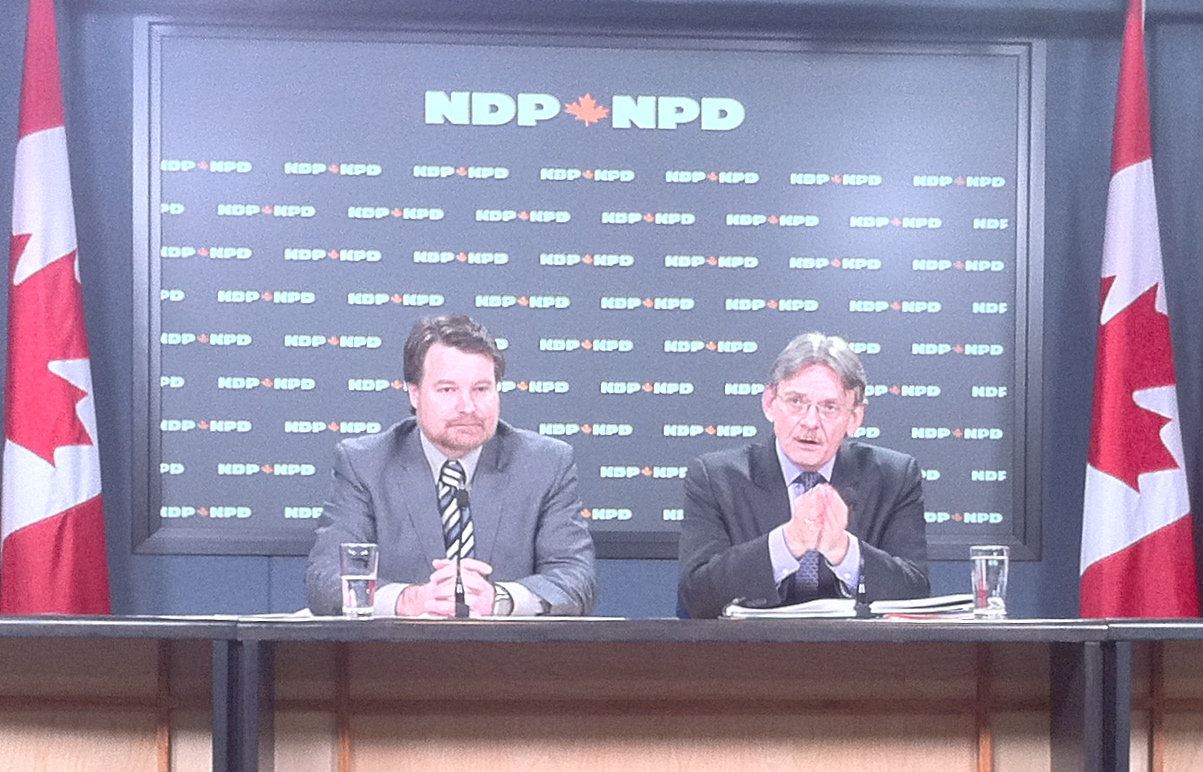
It was the NDP’s turn to talk about the F-35 process, and their defence critic, David Christopherson, and public works critic, Matthew Ravignat, who presented themselves at the National Press Theatre to discuss the situation. Christopherson started off saying that while MacKay had assured the press that the F-35s were the best value, we can never know that since there was never a competitive bid or tendering process. He then veered off to talk about the submarine programme, and decried how MacKay said yesterday that all four subs would be in the water by 2013, and yet responded to an Order Paper question weeks ago saying that the HMCS Cornerbrook will be in drydock until at least 2016, never mind the fact that we don’t have enough trained crews to maintain operational readiness.
Ravignat, however, had somewhat harsher words for MacKay.
Roundup: Branding Mulcair
The NDP have launched their English-language ads about Thomas Mulcair, which is mostly a bunch of b-roll people saying how great Thomas Mulcair is, at which point Olivia Chow says that Layton’s vision is in good hands, and Mulcair gives his pledge to “get the job done.” And hey, the party has been buying up some prime ad space too. Mind you, it seems these scripts were done up before the leader was even chosen, but considering how much in “violent agreement” they all were about policy it wouldn’t have affected the outcome much one way or the other.
Good news, everyone! Peter MacKay promises there will be more transparency with the F-35 going forward. Great. Now what about a proper procurement process that isn’t rigged and predetermined? Maybe? No answer. Meanwhile, Laurie Hawn seems to think that the Auditor General doesn’t know how to do his job, while Peter MacKay seems put out that DND will have to actually calculate operational lifetime costs as part of procurement – you know, like Auditors General have been asking for, for years now. The poor little lamb. Oh, and former Assistant Deputy Minister Alan Williams? Is still not buying any of these accounting excuses, for the record.
Another of our submarines is (finally) ready for sea trials, making that two now in the water. Meanwhile, it seems the navy may have some training issues with crews for said submarines, which really can’t be a surprise given how long they’ve been in drydock.
It appears that Canada will be setting up a separate immigration system for skilled tradespeople to deal with all of those labour shortages in places like Alberta.
Here is an accounting of how John Baird picked up the phone eight times to “lobby hard” against a vote for recognition of Palestinian statehood at the UN.
Just like the Manning Centre does for the Conservatives, the nascent Broadbent Institute has a poll that shockingly supports the NDP’s partisan position. I know – I’m just as surprised as you are.
Here’s a glance at the thirteen Senate “hopefuls” in Alberta’s “nominee election.” Note how they’re running under provincial banners for seats in federal caucuses – because that totally makes sense.
Here is a look at just what those cuts coming to the CBC will be, including the closure of foreign bureaux and the cancellation of two current affairs shows.
And one of Michael Ignatieff’s old novels, Scar Tissue, is being given new life as a theatre production in Vancouver.
Roundup: How to run a procurement process
On the F-35 file, former Assistant Deputy Minister of procurement at DND, Alan Williams, has a few criticisms of his own of the Auditor General’s report – that it wasn’t nearly scathing enough – that the process that Harper is putting into place is just making things worse, and walks us through the steps of a properly run process to purchase fighter jets, and how the process to replace the CF-18s should be revamped from top to bottom. It’s a must-read on the entire debacle.
Meanwhile back at DND, there are more problems with the procurement processes for upgrading our frigates and maritime patrol planes. This doesn’t bode well for the state of oversight within the department.
In the event you haven’t seen them yet, the NDP have put out ads to start branding Thomas Mulcair’s image, with the rolled sleeves and all. They’re trying to do this before the Conservatives start their own ads, and while Rae is giving him a public beating over turning into a “Mini-Harper.”
Despite what has been speculated after Rae’s big fiery speech on Wednesday, he’s still not running to be permanent leader. At least not yet anyway. And no, Justin Trudeau isn’t running either.
Here’s a look at some of the hidden “back office” costs when it comes to imposing new efficiencies in public service departments in order to enable the staffing reductions. Hint: Efficiencies don’t come for free.
The Governor General is off to France to participate in ceremonies marking the 95th anniversary of the Battle of Vimy Ridge, which was a defining moment in our history.
And Susan Delacourt muses about the Twitter vs. Tim Hortons “schism” that Charlie Angus alluded to in his big tirade while leaving the Twitter Machine. It seems to Delacourt that regardless of the venue, the value is in listening and interaction.
Roundup: The AG’s latest explosive revelation
Speaking to the media yesterday morning, the Auditor General confirmed that the government would have known about the more accurate $25 billion price tag for the F-35s before the last election, based on the documents at DND that he saw. Which is a pretty big deal, considering it calls into question everything that Harper has been saying not only during, but since the last election. In fact, Bob Rae was so outraged that he is moving a motion of privilege in the House of Commons, saying that it is a fundamental right for Parliament to be told the truth, and if the government deliberately misled the House, then there must be consequences. Oh, and the PMO? Put out a release that tries to “clarify” their numbers, saying the previous figure didn’t include a bunch of numbers that the Parliamentary Budget Officer’s did, which sounds a bit rich at this point.
Here is another attempted explanation as to what and was not a “contract” or a Memorandum of Understanding with regards to the F-35 purchase, and how that added to the confusion. Here’s a look at how DND bullied other departments into signing on by using threats of the loss of industrial benefits. Brian Stewart muses about how this debacle fits into the “culture of secrecy” in the government.
NDP leader Thomas Mulcair gave a speech at the Economic Club of Canada to show that the NDP can be sound fiscal managers, and to talk about how he’s not opposed to the oil sands per se, just the way in which they’re being developed.
A Quebec judge has put an injunction on scrapping any long-gun registry data from Quebec.
Attawapiskat will no longer be under third party management, ostensibly for because conditions have improved there, but some – like Charlie Angus – believe it’s because the government is covering its tracks for blowing the file.
Here’s a look at the effect the closure of Rights & Democracy is going to have on places like Burma, where the agency was doing good work.
And here are five things you need to know about public service job cuts.
QP: Never mind the F-35s, look at these job numbers
The Thursday before a holiday Friday, the House benches were a little emptier than usual, and QP held in the morning as it would be on a Friday. But unlike a Friday, it wasn’t entirely manned by the B-Teams of any particular party, as both Harper and Rae were present. Mulcair, however, was absent, and it was up to Joe Comartin to demand answers on what cabinet knew with regards to the F-35 fighters. Harper reminded him that they haven’t actually purchased any planes but will do with a new process in the future, before he veered off to new job numbers in order to try to change the channel. Christine Moore continued on demanding ministerial accountability, but Rona Ambrose reminded her that the Auditor General only wanted new cost estimates tabled and that they’re going above and beyond that with the new secretariat. Standing up for the Liberals, Bob Rae asked when Harper knew the proper costs per the AG’s report. Harper dodged and talked instead about how no planes were purchased, and that they have a new process.
Round two started with Matthew Kellway basically repeating Rae’s question – albeit less eloquently (MacKay: new process!), Malcolm Allen and Lysand Blachette-Lamothe continued those questions (Ambrose: Independently validating new cost estimates), Jack Harris and Ryan Cleary asked about the failure of the search and rescue system in Labrador (MacKay: ground search and rescue is a provincial responsibility), Alexandre Boulerice and Peggy Nash asked about Paradis’ staffer taking a trip to Vegas on a government credit card (Van Loan: Costs were recovered and he’s now a former employee). Marc Garneau compared Peter MacKay to the captain of the Costa Concordia on the F-35 file and demanded his head (MacKay: the AG says that we’ve responded appropriately and no money has been spent), Carolyn Bennett wondered what other things the $10 billion nearly misspent on the F-35s could have gone toward (Fantino: No money was misspent so no worries), and Gerry Byrne hammered home the point of the AG’s words (Ambrose: We have a new process!). Dionne Labelle and Craig Scott asked about CBC cuts (James Moore: the CBC has enough funds to fulfil its mandate), and Nycole Turmel and Paul Dewar asked about public service job cuts (Menzies: Look at the new job numbers!).
Round three saw questions on job cuts on military bases – especially in Quebec, a veteran being denied health benefits, old Conservative promises on cutting taxes on gasoline when it reaches a certain price (Paradis: You guys wanted to raise gas taxes), cuts to CMHC, the cuts to Katimavik, the education funds being withheld in Attawapiskat (John Duncan: The money is in the account as of today), and the court challenge on the long-gun registry data.
Sartorially speaking, snaps go out to Greg Rickford for a superbly tailored dark grey suit with a white collared shirt and a purple tie and pocket square, and to Judy Foote for a grey suit jacket and white top. Style citations go out to Jean Rousseau for a fluorescent blue shirt/grey suit violation, and to Lois Brown for a black suit with a bright yellow collared shirt.
Lord and Smith Commission, Episode 2
My friend Destine Lord and I have a new video up, wherein we talk about the federal budget and the Auditor General’s report on the F-35 procurement process.
Also, we got the lighting a bit better, but while we aimed at making a shorter episode, well, it didn’t quite work out that way. Blame it on a rich news week.