
The Commons justice committee did their clause-by-clause review of the prostitution bill, and they agreed to two minor amendments – one that narrowed the reach of the communication provision from anywhere that children could be present, to simply being next to schools, playgrounds of daycares; the other being that they agreed to put in a provision to review the bill in five years, though the NDP tried to get that down to two. The Liberals didn’t put forward any amendments since they voted against the bill in principle at second reading, feeling it is unconstitutional and unsalvageable. The Greens largely feel the same way. Interestingly, Independent MP Maria Mourani doesn’t feel it goes far enough, and wants prostitution outlawed writ large. Here’s a look at some of the criminalization of both the sex workers as well as pimps and johns in Canada, and apparently we have fairly low rates of going after those who abuse sex workers – but one wonders if that also has to do with the fact that the women who were abused or assaulted didn’t feel safe reporting it because they feared being further criminalised.
Tag Archives: Civic Literacy
Roundup: Missing the point about parties
In a piece that bothers me immensely, Susan Delacourt puts forward the notion of abolishing political parties, and then applies a bunch of marginal reasons like branding and narrowing voter pools. The problem is that she ignored the whole point of political parties under Responsible Government – to have a group that can maintain the confidence of the Chamber in the formation of government. Which is actually a pretty big deal and why coalition governments don’t really work as well in our system as they might in others. “Oh, but Nunavut doesn’t have parties” or “most municipalities don’t have parties” people – including Delacourt – will cry, but it’s a nonsense argument because they have a small handful of members, and it doesn’t scale up to 308 MPs on any practical basis. You could not adequately run a government or maintain confidence with 308 “loose fish.” Also, the notion that brokerage is “antiquated” is false – otherwise we’d see all kinds of “bridges to nowhere” riders in government bills to get MPs onside to win support – again something that would be endemic with trying to get the support of a chamber of independents. That’s not to say that there aren’t problems with parties right now, because there are, but the solution is to have more people engaging with them so that the power doesn’t remain concentrated – not to simply throw the baby out with the bathwater. Sorry, but Delacourt’s argument has no merit.
Roundup: Four new workers!
It’s a special kind of desperation for a good news story when the government holds a press conference to announce four new jobs being filled. Specifically, four jobs on the Irving shipyard refurbishment in Halifax, which will be filled by Aboriginals. I’m still not sure the point of the announcement other than Peter MacKay saying “Look, we’re being diverse!” only they’re not even government positions (though they are getting a lot of government money). Sure, it’s nice that Irving has an Aboriginal employment strategy as part of its contracting procedures, but this was worthy of a government press conference? Sorry, but the news cycle isn’t that slow.
Roundup: Tepid pipeline approval
At long last, the government has made its decision on the Northern Gateway pipeline, and it’s not wholly unexpected, but surprising in other ways. For one, it sent it out as a press release rather than making a formal announcement. For another, it gave a half-hearted and somewhat mealy acceptance of the proposal, but only if Enbridge can meet all of the National Energy Board’s 209 conditions, plus having them get the First Nations all on-side, plus getting BC on-side as well. As economist Andrew Leach noted, it’s like the government is trying to distance itself from the regulator, the proponent, and any responsibility to get the pipeline built. After all, they do have a tremendous penchant for absolving themselves of responsibility wherever they can, and in this case, there is almost a sense that they’re inviting it to fail. Reaction was swift from the NDP, who declared that if they form government in 2015, that the pipeline would be cancelled immediately, and warned of “social unrest” in the meantime. The Liberals, however, took a slightly more nuanced approach – while they called for the rejection of this particular pipeline (they do support Keystone XL), but Justin Trudeau made the observation that the Crown – basically the government – has the obligation to consult with First Nations, not companies like Enbridge, so that throws yet another wrench into the plans o f the government. There are questions as to whether the decision will hinder Conservative re-election chances in the province, but I have a hard time seeing how it would with the “Bible Belt” ridings in the southern part of the province that the Conservatives hold quite comfortably. Enbridge says the decision gives them the time they need to get it right. Here are five other pipeline projects to keep an eye on. John Geddes notes the amount of work that Enbridge is being asked to do, while remembering that BC is the home to some memorable environmental protests. Paul Wells looks at the electoral calculus of the decision, while Leach has a Twitter conversation with Elizabeth May about her comments, and how they don’t actually make sense.
Roundup: A blistering report
Word has it that House of Commons Administration has an independent report prepared on the NDP’s “satellite offices” that will be presented to the Board of Internal Economy, and that it’s going to be blistering. And because this is coming from Commons Administration and not any of the parties or committees, it’s going to be difficult for the NDP to blame this on partisanship or that they’re being ganged up on, which are their usual defences. Unless of course they’re going to claim that the Commons Administration is also out to get them…
Roundup: An office to serve non-existent MPs
The NDP are trying to open yet another Hill branch office, but this time in Saskatchewan – where they don’t have any MPs. In other words, trying to claim that it’s for parliamentary work is utter bunk. And “outreach officer” is not a Hill staffer position, by the way. When they claim that they need to be in touch with all Canadians, that’s not the job of Hill staffers – that’s the role of the local riding associations. Their associations are supposed to be the interlocutors between the local communities and the parliamentary party and caucus, a model that is ever weakening in the age of instamembers for leadership votes, and power centralized in leaders’ offices. That the NDP are trying to knock down those barriers between party work and Hill work is another worrying trend about the level of centralization that they are employing.
Roundup: So long, Alison Redford
In a somewhat surprising move, Alberta premier Alison Redford resigned last night, effective Sunday evening. It sounds like she’ll be staying on as MLA for the time being, but man, that’ll be a tough gig. Jen Gerson notes that for all of her skill at policy, Redford lacked political instincts and was in fact the victim of her own transparency laws as her own spending came to light. Colby Cosh reminds us that this really had little to do with the cost of the South Africa trip, but was a long simmering series of problems that kept building until Redford finally collapsed under the weight of them.
Roundup: Shenanigans and filibusters
It was a day of procedural shenanigans in the House, with the government trying to tie up the debate around the Brad Butt privilege issue, while in committee, the NDP were continuing their filibuster around the issue of holding cross-country hearings on the elections bill. In the end, closure came down and the Butt issue went to a vote, majority ruling not to send the matter to committee (most Conservatives insisting that his apology was enough and that he really didn’t mean to mislead the House – though nobody had explained how exactly that was the case), and the NDP got concessions on the elections bill at committee – more hearings would be held, but only in Ottawa, while the party decided to hold their own hearings across the country on their own.
Charlie Angus’ wrongheaded understanding of our democracy
It was no surprise that NDP-turned-Independent MP Bruce Hyer joined the Green Party, if you’d paid the least amount of attention to the House of Commons over the past year or so. Hyer did flirt with the Liberals to a small extent, expressing support to Joyce Murray’s leadership campaign because of her stance on things like proportional representation, but really, Hyer and Elizabeth May have become quite the pair in the far corner of the Commons.
What was also not a real surprise was the outrage that the NDP would show over the move, and what should not have been a surprise was the stunning degree of civic ignorance demonstrated by Charlie Angus in his press release denouncing Hyer’s move.
The romance with half-assed reform proposals
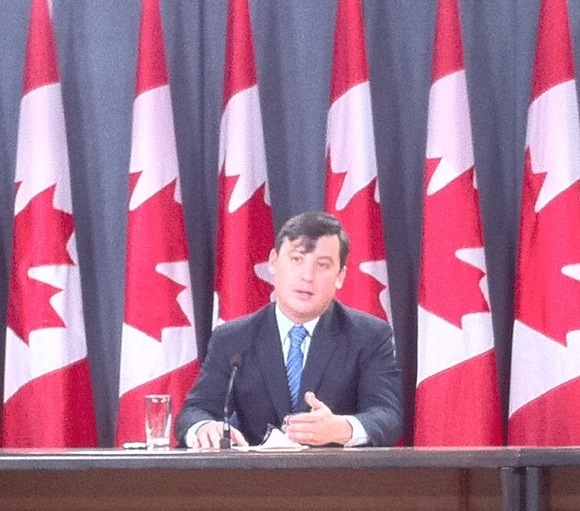
Throughout his press conference this morning around the introduction of the Reform Act, 2013, Conservative MP Michael Chong insisted that the changes he was proposing would simply bring Canada back into line with other Westminster parliaments such as the UK and Australia in giving the caucus the power to dismiss the leader. This, however, is not exactly the case. It relies on the omission of the key fact that the ways in which these parties tend to select their leaders impacts on the ways in which they can overturn them.