
Roundup: Prison closures looming

The government has announced that they are closing down the Kingston and Leclerc penitentiaries, as well as the Ontario Regional Treatment Centre, a mental health facility for inmates within the Kingston facility. But don’t worry, Vic Toews says – they have plenty of capacity in other facilities (which is not exactly true, seeing as there are different kinds of capacity in different facilities, and we have seen a rise in double-bunking), and we haven’t seen the great spike in prisoner population that everyone was afraid of. Err, except they’ve only just passed the omnibus crime bill, and it’ll be a couple of years before that boom will likely happen (and to be fair, the lion’s share of that burden will be borne by provincial institutions, with all of those two-years-less-a-day mandatory minimum sentences). The closure of the ORTC is probably most concerning because as it stands, there is already a gross lack of capacity for mental health services in prisons – and yet psychologists and mental health nurses have been given layoff notices. It’s also concerning that Toews feels that the provinces should be re-institutionalising more mental health patients rather than locking them up in prisons, but provincial health authorities have moved to release more people with mental health concerns into the communities, where they then wind up in prisons. Toews can’t simply wish this vicious cycle away. Suffice to say, Kingston was an ancient facility that was due to close years and years ago, but the fact that there seems to be little in the way of plans to keep up with appropriate capacity, and the fact that the government still hasn’t provided with costing or even detailed plans of their prisons agenda makes this a concerning enough issue.

Given the amount of research capacity that is being cut at Environment Canada, here is a look at how their mandate is going to start changing over the next few years. One of those changes includes the closure of the BC oil spill office, which Peter Kent dismisses as only providing information on sensitive areas and not actually cleaning up oil spills. Seriously. Meanwhile, cabinet is giving itself the veto power over pipeline projects, despite what the National Energy Board may rule on any project, which pretty much makes any pretence of rigour meaningless at this point. But it’s all for the economy, which is still fragile, everyone!

In case you missed it, here is the recap of yesterday’s Public Accounts meeting on how they’re going to handle looking into the Auditor General’s findings on the F-35s. The takeaway – that the Conservatives, by their actions and votes, look like they’re going to use their majority to hold a bare minimum of meetings (say, one hour for the AG, one hour for the PBO, and two blocks of a half-dozen deputy ministers who will each pass the blame around), and the report will come down saying “see, not our fault, blame the bureaucrats. Or maybe I’m being cynical. Meanwhile, The West Block helpfully compiles the F-35 paper trail.

Meanwhile, Peter MacKay has another defence procurement headache at his feet, this time over armoured infantry vehicles, where the process was halted by fairness monitors and now needs to be restarted. How long will MacKay’s Teflon coating resist these mounting, embarrassing, screw-ups on his watch? Or, more importantly, when will the government actually undertake to radically reform defence procurement in this country so that it’s actually a coherent process under a single accountable authority?

And here is Thomas Mulcair’s new shadow cabinet – three deputy leaders and critic roles for almost everybody! Some of the choices are pretty peculiar (Charmaine Borg for digital issues, when she allegedly didn’t even have a cell phone until she was elected? Joe Comartin to democratic reform? Linda Duncan to Public Works? Jinny Sims to immigration?), and I’m especially curious why this was a press release after 5.30 last night. But I’m suddenly picturing a return to scattershot Question Periods where they try to give questions to everyone, and diffuse any momentum that was possible.
Public Accounts vs. F-35s: Procedural chaos

The Public Accounts committee’s first meeting on the study of the Auditor General’s report on the F-35s was a battle of duelling procedural motions as the government tried to set the timeline further into the week, versus Liberal Gerry Byrne’s motion to accelerate the pace, much to the exasperation of NDP members.

Conservative MP Andrew Saxton’s motion, which was up for debate first, would see the planning meeting for the hearings to be held on Tuesday the 24th, with the suggestion that they begin hearing witnesses on the following Thursday. But when pressed as to why they didn’t use today’s meeting to do the planning session, the government offered no excuse, only that they wanted to “set forward a clear process” to move forward.

Continue reading

Public Accounts vs. F-35s: Preview edition

Liberal MP Gerry Byrne held a press conference this morning to preview this afternoon’s meeting of the Public Accounts committee, where they’re going to lay out the process by which they’ll examine the Auditor General’s report on the procurement process for the F-35s. Byrne has a relatively open-ended motion before the committee that includes a suggested witness list, a list of documents he wants tabled, and the provision that they begin immediately.

But the Conservatives aren’t quite so keen. They’ve tabled a competing motion which says that sure, they’ll begin a study on that chapter of the report, but they don’t want to meet to start scheduling witnesses until Tuesday, and they don’t have any suggested witnesses or requests for documents.

So why is this difference important? Byrne says that by beginning immediately, they can hold a full day of hearings starting tomorrow, rather than the four hours a week that the committee is allowed to sit while the House is in session. (He wanted to start this past Monday, but NDP committee chair David Christopherson called the meeting for today, and he respects that decision). He is also concerned that because the Conservative motion is less open-ended, that the Conservatives will use it to limit the number of meetings held and witnesses heard from in order to keep the process and investigation under wraps. The Conservatives have publicly said that they won’t support his motion – only their own, and they do hold a majority on the committee as well.

“There is no games being played unless my motion is defeated with no explanation, and with no alternative witness list actually being presented at that point in time,” Byrne said, and reiterated that he’s quite open to friendly amendments with regards to witnesses.

Byrne suspects that the Conservatives are trying to take control of the issue after the hammering they’ve taken in the media over the past two weeks. And if they try to take the meeting this afternoon in camera, he will let the media know what went down behind closed doors, even if it opens him up to a charge of being in contempt of parliament.

“Holding a public accounts committee in private is a bit of an oxymoron into what public accounts are what all about,” Byrne said. “It’s contemptible – the real contempt of parliament here is holding such important meetings in private and trying to basically squander the opportunity that’s available to us.”

Roundup: Affidavits and quashed excuses

In today’s Robocon revelations, it seems that in at least six ridings where misdirecting robo-calls were reported, there were actually no polling station changes, thus negating yet another Conservative talking point or excuse. Meanwhile, as part of the court challenge trying to overturn the results in those ridings, an affidavit emerges from a former employee of RMG who tells about making misleading calls based on scripts provided. Naturally, both the Conservatives and RMG have disavowed this, and call the affidavit false.

At an open government conference in Brazil, Tony Clement says that the government won’t give details on the full extent of the cuts until the spring of 2013. Seriously. Because this is the most open and transparent government in Canadian history, everybody!

Professor Stephen Saideman looks back at the excuses of interoperability and economies of scale when it comes to deciding to go with the F-35, and how that’s quickly becoming a moot point, while Canada still hasn’t run a competitive bidding process.

The papers to transfer Omar Khadr back to Canada have now been received by Vic Toews’ office. I’m sure they’re not searching for more ways to deny his repatriation under the notion that he’s somehow a grave threat to national security and that he (falsely) confessed to murder.

Thomas Mulcair has officially moved into Stornoway. Plus, here’s some of the changes in his backroom.

Bob Rae writes about the partriation of the Constitution, and lobs a couple of grenades at the NDP over the Sherbrooke Declaration in the process.

After years spent arguing that it was necessary, the Canadian Forces are closing their west coast intelligence office two years after it was established.

John Ivision delivers a blistering denouncement of the government’s use of secrecy with the environmental changes and the F-35s – and the public’s willingness to swallow it, while Andrew Coyne gives the Liberals some hard truths that many Liberals are acknowledging is a truth they need to deal with.

And Olympic gold medallist Adam Van Koeverden gives an ode to Katimavik, and thanks it for his very existence, as that is where his parents met.

Roundup: Happy Birthday, Charter!

As it is now the 30th anniversary of the patriation of the Constitution, and the adoption of the Charter of Rights and Freedoms, we can expect some words of congratulations from the Prime Minister, right? Well, no. You see, Harper has decided that the Charter is too linked to the “divisive” issue of patriation, and how Quebec didn’t sign onto the Constitution, so he’s going to keep quiet. Which is pretty interesting, considering that he’s just feeding into the myth that Quebec didn’t support patriation (much like the so-called “Night of the Long Knives” myth, perpetuated by separatists). So not only does he appear to be spiting the Charter out of partisan considerations, terrible Liberal document that it is – despite it being more of a libertarian document than anything else – but he feels needs to feed the separatist rhetoric. (Paul Wells shares his views here). Not that either Jean Chrétien or Thomas Mulcair go blameless here either, if you cast your eyes back ten years ago and what both said back then.

Still on the Charter front, from Britain’s National Archives comes a tale from the cabinet minutes of Thatcher’s government, who were considering rejecting the Charter of Rights and Freedoms as part of the constitutional patriation process. Closer to home, former Supreme Court Justice Louise Arbour looks at the impact of the Charter 30 years later.

On the Robocon file, it seems that Elections Canada’s investigation into the Guelph robo-calls has taken them to Conservative Party headquarters, and they’re looking into missing log-in information on the CIMS database, considering that the contact list provided by RackNine matches the CIMS list entirely. Meanwhile, NDP MP Pat Martin has apologised for unfairly maligning the calling firm RackNine over the whole Robocon affair – the second apology he’s had to make in the course of this issue (the previous one being to campaign research). And yes, it was almost certainly to avoid a lawsuit, though it’s not clear that this was enough to ward it off. This is why I keep questioning the wisdom of the NDP putting Martin out in front every time a story like this happens – yes, they know he’ll light his hair on fire in outrage, and he’s even aware that it’s why people come to him for quotes, and he says something outrageous, and the party gets press, but it almost always ends up badly. You’d think that the NDP would learn eventually, but I guess not.

Here’s an excellent breakdown – complete with coloured charts – about the “differences in accounting” when it comes to the cost of those F-35s. Meanwhile, here is a look at the mess that is the procurement process for the Cyclone helicopters, which should serve as a cautionary tale for what could very easily go wrong (and already appears to be going wrong) with the F-35s.

The government is axing a prison rehabilitation programme designed to help lifers who get parole, and has been able to claim success. But since their plan seems to be throwing more people in prison for longer with fewer programmes available to help them rehabilitate, axing this kind of programme makes perfect sense in their twisted logic.

And Bob Rae’s resolve not to run for the permanent leadership of the Liberal Party seems to be slipping, if this timeline of quotes is any indication.

Roundup: Questions about online voting

Experts in online voting have questions about the way that the NDP vote and cyber-attacks were handled, and raise some real doubts about online voting in general, because it means we outsource our most basic democratic rights to small contractors with almost no oversight, and no way of checking the veracity of the votes cast. (Possible paywall). Not to mention, all of the work we’ve done to ensure secret ballots are for naught anyone can set up their own “internet polling station” and watch as people cast ballots, and reward them accordingly. Hello, rum bottle politicking.

Remember how they took Rob Anders off of Veterans Affairs committee for falling asleep and snapping at those veterans making the presentation? Well, they stuck him over on the joint Senate-House committee on the scrutiny of regulations, where he’s decided to start going after regulations concerning gun control.

As previously mentioned, at the Summit of the Americas this weekend the topic of legalising drugs was on the agenda, although funnily enough, many Central American countries are saying they have no choice because America can’t control its consumption of narcotics. And so, both Canada and the US were singled out over the issue, as well as the insistence on keeping Cuba out of the summit. Harper did admit that the current issue wasn’t working, but didn’t offer up any solutions other than that drugs are bad. Okay, then.

Also while in Colombia, Harper continued to insist that the different F-35 figures were just differences in accounting, and that they’ve known the full costs for some time. So he’s admitting that they low-balled the public figure and just told the public the more palatable version? Really? Nothing to see here, move along?

Stephen Harper’s Labour Day trip to New York to attend a baseball game and Broadway show with his daughter cost the public purse $45,000. Oh, but don’t worry – he reimbursed us for the “equivalent commercial cost,” but wouldn’t say what exactly that was, which leads me to believe it was his usual tokenism of paying the economy fare (unlike say, when Paul Martin made it a policy to take the highest rate and then double that). And normally I don’t care that a PM has to take his jet to do stuff that most other people could do because of security – so long as you treat it as a matter of fact, and don’t give insulting reimbursements like economy fares. But also, did he really need to take his staff photographer, press secretary, and executive assistant with him? Really?

There are new explosive allegations of political corruption with the construction industry in Quebec. I’m sure that Thomas Mulcair will be “profoundly saddened” by the reporting of these events.

And here is a reminder that the patriation of the Constitution, which we’re celebrating the 30th anniversary of on Tuesday, is about more than just the adoption of the Charter of Rights and Freedoms, while Philippe Lagassé looks at the way Crown Prerogatives interact with the Charter in light of the 30th anniversary of its inception, plus a tale about the document itself, and attempts to preserve it from the ravages of time.

Roundup: A pre-emptive strike on Lawful Access

The Supreme Court has struck down the ability for police to do wiretaps without a warrant, even in the case of an emergency, because of failures of accountability. Why this is important now is the fact that the Lawful Access bill is under consideration, which also deals with warrantless access to information and communications. This could be a pre-emptive signal by the Court to tell MPs to drop the warrantless provisions, lest they be struck down the way in which these wiretapping laws were.

A number of Air Canada pilots staged a “sick out” yesterday – calling in sick as a job action to protest the way they’ve been treated by management and the government. I spoke to a former conservative Labour Minister about this issue a couple of weeks ago, and small surprise, she’s no fan of this government’s tactics.

CBC’s Terry Milewski goes through the way in which the government took the $10 billion out of its own figures when it publicly said the F-35s were only going to cost $15 billion, even though their own internal numbers, procurement guidelines, and agreements to include operating costs after previous Auditor General spankings – gave the $25 billion figure.

Here’s a look at the current size of the PMO, and the number of staffers in there making over $100,000 per year. Fiscal austerity everyone!

The government’s “back office” cuts at the military includes gutting Defence Research and Development, whose work saves lives in the battlefield. But they’re supporting our troops, everyone!

Here’s a great speech from Senator Cowan about Senator Eaton’s “foreign money” inquiry, in which he notices a few similarities to laws that Vladimir Putin passed in Russia to keep foreign influence out. This targeting of charities is part of the budget, so we can expect more of this kind of targeting to come.

Susan Delacourt looks at the double standard by which political parties are exempt from the same advertising and marketing rules that the private sector is bound by, which includes Do Not Call lists.

If you’re in the mood for a wonkish look at the Elections Act, Kady O’Malley looks at the clause about foreigners campaigning in Canada, and the debate in 1999 where MPs revising the law didn’t do their due diligence.

Also wonkish but very important is this essay from Liberal MP John McCallum on improving the estimates process. It’s refreshing to see an MP who actually understands that his job is to scrutinise spending and exercise control over the public purse.

Here’s an excellent takedown of “conscience rights” as being debated in the Alberta election.

And here’s a look at how it’s Tom Mulcair in English, and Thomas Mulcair in French.

Roundup: Using the same straw man

With over a thousand borders services personnel on the chopping block, the union representing them has taken a page from Harper’s book and is now warning of the risks of more guns, drugs and child pornography making its way into the country because there aren’t enough agents. Yes, it’s greatly hyperbolic, but you can’t say that the government didn’t ask for it. Meanwhile over at DND, the cuts seem to be creating chaos as the military tries to hold onto hardware as things shake out.

Looking at DND’s own costing guidelines, Colin Horgan finds that the government’s numbers on the F-35 procurement still doesn’t add up properly (possible paywall). Here’s a timeline of questions being asked in the House about the F-35s, dating back to July of 2010, including some video of what MacKay said on TV back then, much of which has been contradicted by the AG, and the motion the Liberals tried to pass about holding a competitive tendering process (which failed when the Bloc voted with the government). Here are the pointed questions being asked in the House back in September of 2010, and the answers that were given then.

We’re cutting aid to twelve poor countries, including Afghanistan, but don’t worry, Bev Oda declares. We’ll still respond appropriately as needed. Meanwhile, we’re trying to convince other countries to help with the West African food crisis, but imagine the message we’re sending by asking for more help while at the same time cutting our own aid budget.

What’s that? The RCMP say that the loss of gun registry records means that it will be harder to trace firearm ownership as part of criminal investigations? And this might be impacting on our international obligations for tracing illicit firearms? You don’t say!

The 30th anniversary of the patriation of the Constitution and the adoption of the Charter of Rights and Freedoms is coming up this weekend, and how will the government be marking the occasion? With a press release. The Liberals are trying to organise some rallies, but it seems like a pretty big deal considering how much they’re spending to mark the War of 1812 and the Diamond Jubilee (which are both important celebrations, don’t get me wrong).

Harper is off to the Summit of the Americas, where he plans to urge leaders to keep up the War on Drugs, as many of those countries look to decriminalisation and other options while they face devastating drug wars.

And Jean Chrétien is now musing that he should have tried to “unite the left” when he had a chance, but he decided to keep his cabinet small so he didn’t. Err, I’m not sure that the handful of NDP seats that were in play at the time would have really helped the Liberals stay in power, and until you can convince the NDP to adopt the free market system, good luck with that merger.

Roundup: No lessons learnt with immigration backlog

Because apparently the government hasn’t learned anything since the last time they tried to impose caps to solve the immigration backlog, the plans to simply legislate it away are likely to open the government up to more court challenges. Meanwhile, language testing is going to become mandatory for certain classes of immigrants, while the government looks to centralise immigrant settlement services.

Here’s a look at how this issue over F-35 costs could impact the way future military procurements are handled, and there are a lot of other procurements on the way. Here’s a look at the way in which military officials told MacKay that the F-35 was the “cheapest option” on the market for future fighter craft, despite the escalating costs. Former Assistant Deputy Minister Alan Williams continues to shred the government’s numbers, including the fact that they were actually planning to buy 79 jets, not 65 (remember those 14 replacement planes that Garneau mentioned yesterday morning? And it this is an example of contract splitting, that’s actually strictly prohibited). And Andrew Coyne takes MacKay to task, and breaks it down that this issue is ultimately not about planes, but about whether we live in a functioning parliamentary democracy, or even want to – which is what we all need to remember when we get bogged down in accounting issues.

About 5500 public service layoff notices were given yesterday, including a big number from Border Services, Canadian Food Inspection Agency, and policy positions in Health Canada. Here’s a look at the cuts being made to the military, which includes virtually eliminating parts of our air defence.

The government released its greenhouse gas emissions report yesterday and wow, we’re already a third of the way to our 2020 goals! Err, except that we’ve actually increased slightly from 2009. And while there is a patchwork of provincial plans, we still have no federal plan, despite having been promised one for years, which means that they really had no role to play in any reductions that were made. (More detailed breakdown here, but possible paywall).

There is a good chance the election results in Etobicoke Centre could be overturned in an ongoing court challenge. This is also a warning as to some of the lax training by Elections Canada officials out there.

Conservative MP Bob Dechert touts how religious freedoms “trickle down” to other freedoms in society, rather than you know, focusing on human rights in general and that including religious freedom. Also not mentioned – how creating an office to focus specifically on religious freedoms gives the impression that Canada operates on a hierarchy of rights, privileging religion over other rights in its foreign policy.

Here’s a look at what the demise of Assisted Human Reproduction Canada means at a provincial context – in this case, Alberta.

Joe Clark talks about the Conservatives’ damage to our foreign policy here, with a few observations on the rise of the NDP.

And Bob Rae recalls the debates that brought about the Charter of Rights and Freedoms, 30 years ago.

Decrying MacKay’s “sad spectacle”

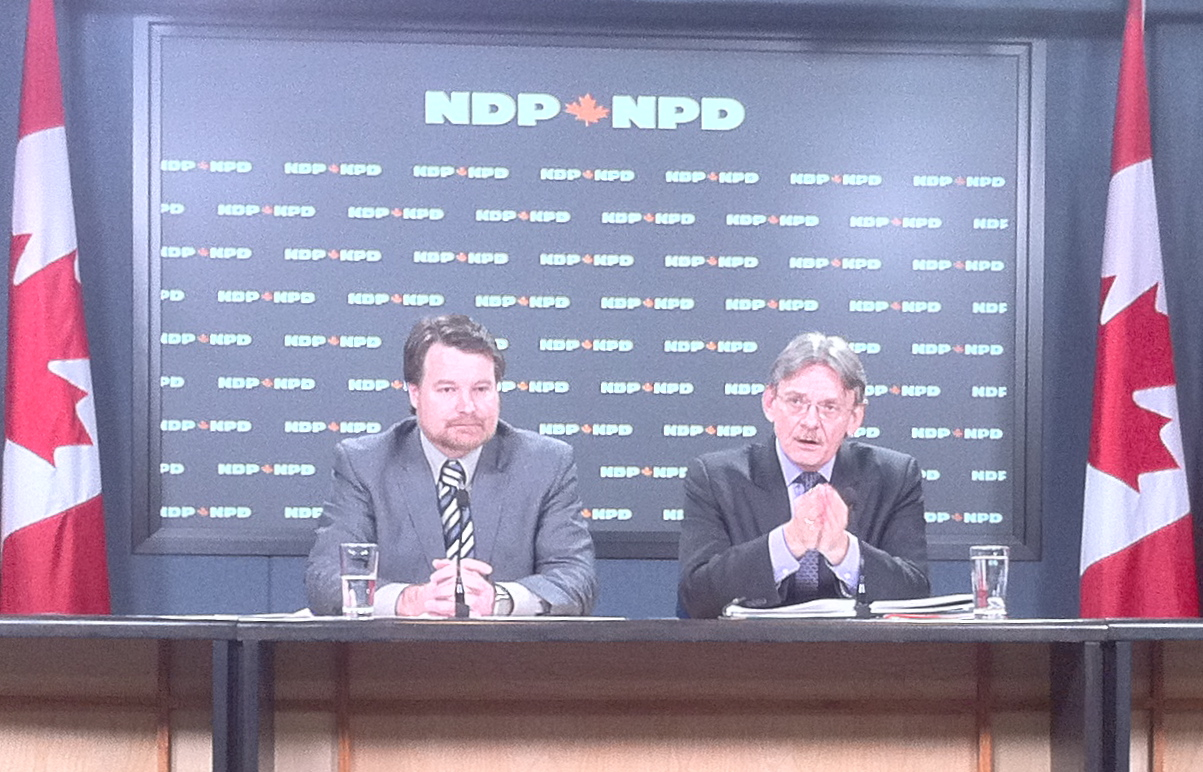
It was the NDP’s turn to talk about the F-35 process, and their defence critic, David Christopherson, and public works critic, Matthew Ravignat, who presented themselves at the National Press Theatre to discuss the situation. Christopherson started off saying that while MacKay had assured the press that the F-35s were the best value, we can never know that since there was never a competitive bid or tendering process. He then veered off to talk about the submarine programme, and decried how MacKay said yesterday that all four subs would be in the water by 2013, and yet responded to an Order Paper question weeks ago saying that the HMCS Cornerbrook will be in drydock until at least 2016, never mind the fact that we don’t have enough trained crews to maintain operational readiness.

Ravignat, however, had somewhat harsher words for MacKay.

Continue reading