
It seems that some senators have had enough, and they’re not going to take it any more. First we saw Senate Speaker Kinsella bash back at NDP leader Thomas Mulcair’s unfounded smear during Question Period earlier in the week – for which Nathan Cullen went whining to the press about how it “undermined the Senate,” showing that he neither understands the role of the Senate Speaker and how it differs from that of the Commons, nor that Kinsella was simply responding in kind to Mulcair’s attack. That the NDP have built up a huge straw man around the supposed “non-partisan” nature of the Senate – which never has been the case nor was it ever the intention – shows the lengths to which they will construct fictions in order to suit their partisan abolition call. Yesterday we saw Quebec Senator Claude Dagenais unleashing his full fury on NDP MP Charmaine Borg after he received one of her ten-percenters about abolishing the Senate. His public response challenged her assertion that Senators were useless by remarking that constituents whom he has sent to speak to her (their local MP) found her to be useless and powerless, before he suggested that Borg go to the Parliamentary and read up on the institution before she attack it. He then unloaded on the fact that they were only elected by a surge of spontaneous sympathy for Jack Layton in Quebec (and it will be noted that Borg was one of the McGill Four who never even visited her riding during the election). He also has no intention of backing down so long as the NDP continue to attack the Senate. Meanwhile, some Conservative senators are also tired of being given orders by the PMO, and are meeting this weekend to talk about steps to reassert their independence – things like refraining from attending national caucus and possibly establishing bipartisan regional caucuses instead. That’s an incredibly encouraging sign and would go a long way to the chamber reasserting itself after being pushed around by a PMO bent on control.
Tag Archives: Reform Act
Roundup: Mandela, Reform Act and Senate privilege
Nelson Mandela passed away yesterday at the age of 95. Here is the text of his address to the Canadian parliament in 1990 and again in 1998. Maclean’s also has collected the tributes by Canadian MPs over the Twitter Machine.
Today in Reform Act news, Aaron Wherry talks to Michael Chong about the aspect of local nominations and the possibility of rogue operations. I agree that a system like that in several UK parties should be adopted, and I think that Chong is being a bit naïve when he feels that the media will let a leader get away with any nominations that “go rogue,” if the Wildrose party’s reaction is anything to go by in the last Alberta election. Andrew Coyne adds his voice to the call that party leadership selection needs to remain in caucus as well as the ability to remove said leader.
Roundup: Contradictions in energy policy
Thomas Mulcair’s speech to the Economic Club of Canada wasn’t full of a lot of details, but it raised a lot of questions – especially when he started to contradict himself. While Mulcair spoke about an “alternate vision” of development, with particular attention paid to a cap-and-trade system (which he has not yet outlined), and to resurrecting the home energy refit programme. But he also said that he would remove Cabinet’s ability to override a National Energy Board decision, while in the same breath saying that he would never have allowed the Keystone XL pipeline to go for regulatory approval – even though the NEB approved it. In other words, keep cabinet out of the decisions, but arbitrarily empower cabinet to keep it from being allowed to see a decision. Logic! He reiterated that he wants to increase refining capacity in Canada, grossly inflating the number of jobs that would create and ignoring the infrastructure costs (let alone the GHG footprint), but would have denied any way for that refined product to get to market, since he wouldn’t have allowed new pipelines to get approval. Logic. And then he also claimed that he was leader in 2011, by which point the plot was lost.
Roundup: Reform Act reaction
The Reform Act 2013 has now been tabled, and it’s pretty much as has been reported, with the three key areas around the powers around nominations, caucus membership and forcing a leadership review on party leaders. (Text and sixty-second explainer here). Aaron Wherry rounds up some of the declared support today, including from the Conservative caucus, and those now outside like Brent Rathgeber, as well as some of the reaction and analysis to date. Alice Funke aka Pundit’s Guide looks at ways in which the provisions can be subverted by parties or leaders. Tim Harper points out the bill’s silence about a leader having to deal with an unsuitable candidate during an election. Andrew Coyne has a Q&A with Chong about the bill and tries to dispel some of the myths or concerns, but fails to ask some of the more pertinent questions around membership and inputs.
QP: Treasury Board rules are being followed
With Michael Chong’s Reform Act having taken up the morning’s news cycle, it was going to be a switch to get back into battle mode over the outstanding questions in the ClusterDuff affair. As well, Thomas Mulcair was the only major leader in the House once again, owing to appearances at the Demarais funeral in Montreal, which meant another lacklustre QP. Mulcair started off with by wondering who in the PMO asked to find Benjamin Perrin’s emails. James Moore got up, acting as back-up PM du jour for the first time in months, and reread parts of the PCO letter to the RCMP in response. Mulcair wondered why the head of legal operations wasn’t aware that the emails were frozen, but Moore’s response was little different. Mulcair went onto the rules around emails and the concerns of the Information Commissioner, to which Moore reminded the House that she is independent and can investigate if she wishes. Mulcair went onto a rambling question about PMO employees being warned of the investigation, and didn’t get a response from Moore. Mulcair finally wondered why those emails had been hidden if it wasn’t to further a cover-up, but Moore rejected that premise. Dominic LeBlanc was up for the Liberals, and wondered how it was possible to be unaware of the existence of those emails. Moore repeated that PCO admitted their mistake, and that those emails were now in the hands of the RCMP. Ralph Goodale took over and wondered how PCO could say that they didn’t have the emails in response to his own request for them, but Moore stuck to the PCO letter.
The romance with half-assed reform proposals
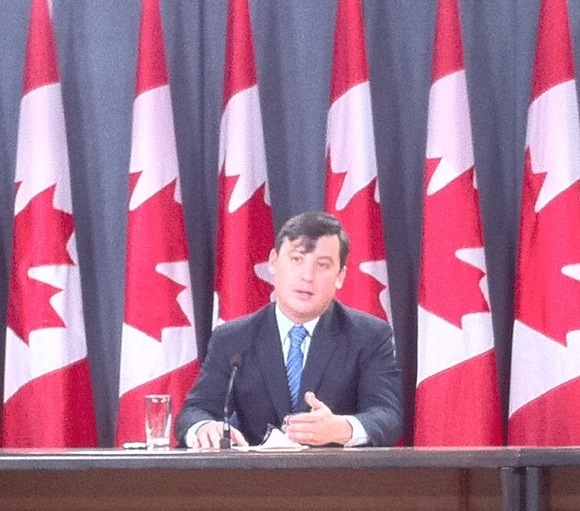
Throughout his press conference this morning around the introduction of the Reform Act, 2013, Conservative MP Michael Chong insisted that the changes he was proposing would simply bring Canada back into line with other Westminster parliaments such as the UK and Australia in giving the caucus the power to dismiss the leader. This, however, is not exactly the case. It relies on the omission of the key fact that the ways in which these parties tend to select their leaders impacts on the ways in which they can overturn them.
Roundup: A lost learning moment
It was an unusual scene, where the Speaker of the Senate arranged a media event inside the Senate chamber. His purpose was two-fold – to give a bit of a lesson to journalists about the history and role of the institution, as he was alarmed that the kinds of misinformation that he’d seen in the media over the past several months; he also wanted to try and answer as many questions as he could at once. Unfortunately, much of the former goal as a “learning moment” seemed lost on many of my media colleagues as they started asking him questions as though he were the person in charge, as opposed to the presiding officer, and as such, it’s not up to him if they end up calling Michael Runia or Senator Gerstein before committee, but rather, it has to be a decision of the Senate. What they did find out was that the Senate is cooperating on getting those emails requested by the RCMP, and that parliamentary privilege cannot shield senators from an investigation.
Roundup: Missing Perrin emails found
The Privy Council Office has found those emails from former PMO legal advisor Benjamin Perrin after all, despite previously telling the RCMP that they had been deleted.Oops. And yes, they promise to turn them over to the RMCP right away. It’s also probably just a coincidence that the advisory was sent out at 9 PM on a Sunday while the Prime Minister was wowing the crowd at a certain Jewish fundraising dinner as well, right? Meanwhile, Tonda MacCharles reconstructs that fateful February day when Nigel Wright made the decision to repay Duffy and tries to figure out where it all went wrong. CBC finds out what happened to Chris Montgomery, the Senate staffer who objected to the PMO interference with the Duffy audit report.