
The Reform Act 2013 has now been tabled, and it’s pretty much as has been reported, with the three key areas around the powers around nominations, caucus membership and forcing a leadership review on party leaders. (Text and sixty-second explainer here). Aaron Wherry rounds up some of the declared support today, including from the Conservative caucus, and those now outside like Brent Rathgeber, as well as some of the reaction and analysis to date. Alice Funke aka Pundit’s Guide looks at ways in which the provisions can be subverted by parties or leaders. Tim Harper points out the bill’s silence about a leader having to deal with an unsuitable candidate during an election. Andrew Coyne has a Q&A with Chong about the bill and tries to dispel some of the myths or concerns, but fails to ask some of the more pertinent questions around membership and inputs.
Tag Archives: The Senate
The romance with half-assed reform proposals
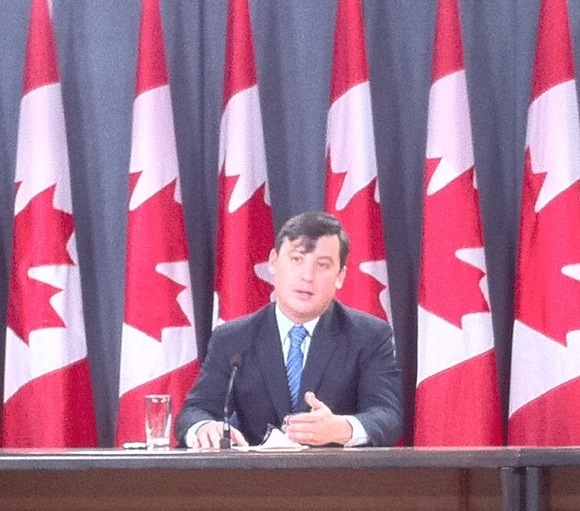
Throughout his press conference this morning around the introduction of the Reform Act, 2013, Conservative MP Michael Chong insisted that the changes he was proposing would simply bring Canada back into line with other Westminster parliaments such as the UK and Australia in giving the caucus the power to dismiss the leader. This, however, is not exactly the case. It relies on the omission of the key fact that the ways in which these parties tend to select their leaders impacts on the ways in which they can overturn them.
Roundup: A lost learning moment
It was an unusual scene, where the Speaker of the Senate arranged a media event inside the Senate chamber. His purpose was two-fold – to give a bit of a lesson to journalists about the history and role of the institution, as he was alarmed that the kinds of misinformation that he’d seen in the media over the past several months; he also wanted to try and answer as many questions as he could at once. Unfortunately, much of the former goal as a “learning moment” seemed lost on many of my media colleagues as they started asking him questions as though he were the person in charge, as opposed to the presiding officer, and as such, it’s not up to him if they end up calling Michael Runia or Senator Gerstein before committee, but rather, it has to be a decision of the Senate. What they did find out was that the Senate is cooperating on getting those emails requested by the RCMP, and that parliamentary privilege cannot shield senators from an investigation.
Roundup: Four by-elections today
At long last, it’s finally by-election day today! Hooray! Toronto Centre has been the centre of a debate on income inequality, while Brandon-Souris, a long-time Conservative stronghold, is being seen as a barometer of the Senate scandals, compounded by alleged shenanigans in the nomination race, which may be driving voters over to the Liberals. Susan Delacourt notices that Bob Rae sent out a letter to Liberal supporters that employed the language of shame-based get-out-the-vote campaigns, talking about names being on voter lists, which NDP MP Craig Scott accused of being coercive, though it has been a proven effective technique where it has been applied. Michael Den Tandt looks at the by-election narratives, and notes the ways in which both the Conservatives and NDP are doing Trudeau’s work, handing him lay-ups, and allowing him to straddle the centre. (He’s wrong that this is Trudeau’s first electoral test – that was in Labrador). Paul Wells is grumpy about the whole thing – and I can’t blame him.
Roundup: The AG wants MP oversight
The Auditor General says that there needs to be an independent, non-partisan body to deal with MPs expenses in order for Canadians to be confident that they are being managed. The NDP immediately point out that this is what they have been looking for since the issue of Senate expenses exploded into the public consciousness. I would say that it’s too bad that we are reaching a place where we can no longer treat MPs like grown-ups, and that we need yet more mechanisms to police them.
Roundup: Another underfunded procurement
As we await the Auditor General’s report, due next week, we hear that he is expected to report that the National Shipbuilding Programme doesn’t have enough money to fulfil its goals. Not that this should surprise us, as the constant delays and rising inflation have driven up the costs. Because this government has clearly done their bit for the procurement file every chance they get.
Roundup: Flaherty’s frozen economic update
Finance Minister Jim Flaherty delivered his fall economic update in Edmonton yesterday, and faced a grilling inquiry by none other than the Conservative chair of the Finance Committee, James Rajotte. Ooh. Flaherty said that there will be a healthy surplus by 2015, paid for by frozen spending (aka de facto cuts when you factor in inflation), and asset sales that haven’t yet happened (which is one-time income, and not sustainable). Any future pay increases for public servants have to come out of those same frozen department budgets as well, which further limits any increases. As you can imagine, it went over like a lead balloon with the opposition. Flaherty also confirmed that he does plan to run again in 2015, despite his health challenges – for what it’s worth. Economist Stephen Gordon has a hard time seeing how the cuts will replace sluggish revenue growth, and remains sceptical about the projections. Former Parliamentary Budget Officer Kevin Page gives his read of the update, and sees a whole lot of missing information.
Roundup: Like a case of beer to a drunk
It has not been the Liberals’ weekend for communications strategies, it seems. After days of enduring the hectoring over “Ladies Night” and the facetious comments that Justin Trudeau made about China, along came the Liberal veterans affairs critic, Jim Karygiannis, where he went on Power & Politics and quoted the director of Wounded Warriors Canada in saying that giving wounded soldiers lump sum disability payments was like “waving a case of beer in front of a drunk,” as many will spend it on houses, fast cars, or their addictions, and he cited examples of these kinds of things happening where he met the individuals involved. And cue the outrage. Said director of the organisation immediately distanced himself from the comments over Twitter, and a few hours later, Karygiannis apologised – sort of. Suffice to say, it didn’t help the perception that the Liberals have their a-game on when it comes to media messaging.
Roundup: Brad Wall’s sound and fury signifying nothing
The news had the NDP crowing, but it’s a lot of sound and fury signifying almost nothing. Over in Saskatchewan, Brad Wall’s government decided to repeal their senate “nominee election” legislation, and pass a motion to declare that they are calling for Senate abolition. Which is all well and good, but that legislation was of dubious constitutionality since the Senate is federal jurisdiction, the selection of Senators explicitly spelled out in the constitution as a Governor-in-Council appointment, not to mention that Wall refused to actually hold these “elections” because Ottawa wouldn’t pay for them. And then there’s the fact that abolition would require the unanimous consent of the provinces to achieve. So Brad Wall set out a marker, for what it’s worth – but it’s hardly going to get any ball rolling, especially before the Supreme Court hears the reference case.
Due process versus the culture of expediency
Stephen Harper’s culture of expediency has marked every single aspect of the ClusterDuff affair, from its genesis with the appointment of those senators in 2009, to the abrogation of due process that took place in the Senate tonight to their suspension without pay. Those appointments, made in haste and without proper due diligence, created the crisis of the independence of the Senate that we find ourselves in currently – but it was politically expedient for Harper to declare that he wasn’t going to appoint “unelected” senators until it became expedient for him to appoint a glut of them at once and strain the ability of the chamber to absorb them.