About Dale

Journalist in the Canadian Parliamentary Press Gallery

Senator McCoy talks about the Independent Working Group

I had a sit-down conversation with Senator Elaine McCoy a few days ago to talk about how things are progressing with the third quasi-caucus in the Senate, the new “Independent Working Group,” or “work in progress,” as McCoy calls it. She was elected the “Facilitator” of the group, acting as a kind of caucus leader and whip on what is promised to be a rotational basis, but merely for administrative purposes – not the other partisan roles of the leader or whip, which is convenient since the Working Group is made up of both former Liberal and Conservative senators, along with McCoy, who always sat as a Progressive Conservative outside of Conservative caucus, and without enough members to qualify for party status, the dwindling Progressive Conservative senators were independents for all intents and purposes.

“It’s coming along very well,” said McCoy of the Working Group. “We are designing it as we go. We couldn’t call it a caucus because several of us said that we are definitely not asking a political leader to recognise us, and we’re not gathering together for political purposes if you think of that in the sense of political party purposes. Our rules don’t leave us anywhere to go in calling ourselves a ‘caucus,’ so we’re hoping that that definition will change, and there are some of us who would be happy to call ourselves a caucus.”

Continue reading →

Roundup: New paths to power

If there was any particular proof needed that things are indeed changing in the government, the way in which decisions are made is a pretty good place to start, as Susan Delacourt explores over in Policy Options. Gone are the days when all paths lead to the PMO, but rather individual ministers are empowered to make decisions, but at the same time, they are expected to consult with provincial and territorial counterparts. The civil service, having grown used to not being asked to draw up an array of options for shaping policy, is now a “fixer upper,” while the new dynamic makes it possible for anyone to contribute to policy discussions, meaning that the government can draw from a bigger pool of ideas. And the new buzzword of “deliverology” means that goals are being drawn up as tangible things that have knowable results, rather than just abstract dollar figures. (The “guru” of deliverology just met with cabinet at the Kananaskis retreat, where he said that the government has made good progress over the last six months). Commons committees are coming up with policy discussions of their own (not that they’re always going to be taken fully, as the assisted dying legislation shows). We have evidence that the Senate and their legislative agenda is being listened to, with examples like Senator Moore’s bill on restoring parliamentary authority over borrowing being adopted in the government’s budget, and Ralph Goodale talking about how they are considering his bill on CBSA oversight. So yes, it looks like the centre of power is less and less the PMO in this brave new world, which is probably not such a bad thing after all.

Continue reading →

Roundup: A possible pipeline

Pipelines will be the talk of the day, as the National Energy Board gave approval to Enbridge’s Line 3 replacement pipeline to the US late yesterday, and Candice Bergen wasted no time in putting out a press release demanding that the government approve it for the sake of jobs, and so on. Never mind that this pipeline doesn’t go to tidewater, so it won’t actually help Alberta get world price for its exports, but hey, it’s a pipeline and we are apparently in desperate need of them, except when we aren’t because they will encourage the further exploitation of oil and gas which won’t help us reach our climate goals, and all of that. But tidewater remains on everyone’s lips, as there is talk that the Northern Gateway pipeline may not be dead after all, and there is even talk that Enbridge is looking at alternate port facilities than the one that they proposed in their initial bid. There is a sense of a deadline, given that the conditional approval that the NEB gave Northern Gateway would expire by the end of this year, but it’s also hard to say that it was a real approval given the 200+ conditions that they attached to it, which may very well have been quite onerous – particularly any conditions that required First Nations buy-in when they are not keen to allow these pipelines over their territories, nor to have any terminus near the waterways that salmon depend upon for spawning, as that affects their local fisheries as well. That said, all of the agitation for Energy East will continue undaunted, no matter that it hasn’t even begun much of its environmental assessment process, nor the case for its “social licence” as Trudeau likes to call it – not that questions of process seem to matter to those who want it to happen yesterday.

Continue reading →

Roundup: The verdict as reflection on the institution

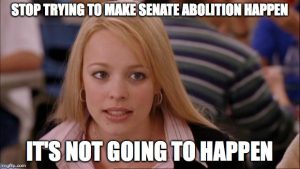
Now that they’ve had a couple of days to digest the events, we’ve got some weekend punditry on the Duffy verdict and What It All Means™ for the Senate as an institution, and well, some of it is really hard to swallow. Rick Anderson has eight thoughts about the expenses issue, and most of them are on the right track, except for number four, which is about the Board of Internal Economy (Commons) and Internal Economy Committee (Senate), and his belief that these bodies are too political to police parliamentarian expenses. The problem with this line of thinking is of course parliamentary privilege – parliament is self-governing. It needs to be. It cannot be brought under the heel of a bureaucracy, because if we can’t trust our parliamentarians to run their own affairs, then we might as well just hand power back to the Queen. Do they get it right all of the time? No, of course not, but this is a democracy and there is an accountability process, and yes, that includes for the Senate. Of course with the Senate, it is much more tied to public pressure, but that public pressure has forced the Senate to make any number of changes in the past few years (they had already started before the whole ClusterDuff affair started, but that certainly accelerated things). This is of course why I have trouble with Adam Dodek’s condemnations of the Senate post-verdict and his (frankly wrong) assertions that nothing has really changed, and his assertion that most senators treat the job as a part-time gig. I’ve known very few senators who feel that way, and most that I’ve met and been in contact with are just as engaged as MPs with their files – even more in many cases when those senators have causes that they are engaged with. The days of senators sitting on a number of corporate boards is drawing to a close as boards are professionalising and the need for a senator as a “prestige” appointment become less common. (I would add that I actually think it’s not a problem for senators to sit on a non-profit board as a way of constituency outreach). And then there’s Michael Den Tandt who retreats to the same old fears about these new independent senators being wholly unaccountable, as though something has materially changed from when they were all in party caucuses (which is false), and that somehow that caucus could keep them more in line (no, not really). Apparently Den Tandt has forgotten that the Senate has institutional independence for a reason, and his musing that the Conservatives should champion abolition by way of a referendum is frankly ridiculous – despite what people may think about a referendum being a tactic to pressure premiers, it returns to the same problem of using majoritarian tactics to pressure minority provinces into giving up their counter-balancing representation. I think I’ll leave this meme here for his edification.
Mean Girls Senate Abolition

Continue reading →

Roundup: Duffy’s long road back

We heard confirmation yesterday from Duffy’s lawyer that he does indeed plan to return to the Senate despite some serious health concerns, not that he’ll find many friends there, which could make things more awkward than they’ll already be. In talking with one senator yesterday, I heard largely that he had few friends there to begin with, and because he spent his time fundraising for the party instead of doing actual Senate work, he never really got to know or ingratiate himself with his actual Senate colleagues, so it’s not like he’ll have a long list of people looking to welcome him back with open arms. And, because it’s unlikely the party will welcome him back, Duffy may continue to find himself on the outside. His lawyer also suggested that perhaps he should be paid back for the time in which he was suspended without pay, but you will find that argument will quickly go down in flames as senators will remind you that their internal discipline process is separate from the criminal trial, and his suspension without pay was internal discipline. And we’ll get a bunch of pundits lazily declaring that the Senate is still lax in its rules and processes, which it isn’t (and I would argue really wasn’t when Duffy was taking advantage of it), and oh look – Scott Reid did just that. Kady O’Malley admits her surprise in the ruling, while Andrew Coyne takes umbrage with “not criminal” as a standard that seems to be emerging. The Winnipeg Free Press editorial board notes how the new, better appointments could help to restore the Senate’s credibility, while CBC looks at what effect the Duffy verdict could have with future prosecutions of other senators’ questionable conduct.

Continue reading →

Roundup: The exoneration of Mike Duffy

It was rather a stunning result, where Senator Mike Duffy was acquitted of all 31 charges against him for fraud, breach of trust and bribery. The judge ruled that he found Duffy to be a credible witness, and said largely ruled that Duffy followed what few rules there were in place at the time, a fact that many would contest – there were rules that Duffy indeed skirted, but not to the degree of criminality, according to the judge. In fact, it goes against the very ruling of former Justice Ian Binnie in his arbitration report, who noted that there were rules and there was also common sense in determining the eligibility of expenses, and while he didn’t rule on criminality, it does contradict some of the judge’s reasoning in the Duffy verdict. That the judge singled out the PMO for scathing words is of very little comfort, particularly because of his belief that they somehow overrode Duffy’s free will in “forcing” him to accept that $90,000 cheque. Duffy is now free to return to work in the Senate, but he may not find it a very welcoming place, given his direct culpability to the hits on the institution’s credibility. That, and there will be eyes on his spending at all times, particularly by those senators who knew that there were rules in place – despite what Bayne and eventually the judge felt – and those rules have only become more stringent since. More from Köhler, Harper and Reevely, while Reevely had a few other thoughts over Twitter that also bear repeating.

Continue reading →

QP: Tax credit meanies

While Justin Trudeau was at Gleason gym in Brooklyn, and the Duffy verdict being read out a few blocks away, QP was ramping up for another scintillating session. In the lead up to QP, MPs sang a round of “Happy Birthday” and “God Save the Queen” in honour of Her Majesty’s 90th birthday, followed by a moment of silence for the National Day of Mourning. Rona Ambrose led off, complaining about the demise of the child sport tax credit. Bill Morneau reminded her that the new Child Tax Benefit offers more money for all families to use as they see fit. Ambrose asked again in French, got the same answer, and then moved onto complaining that the Liberals voted down her motion to declare ISIS a genocide. Stéphane Dion reminded her that the official recognition of genocide was serious and should only happen after an international investigation, which is what he was pushing for. Denis Lebel was up next, asking about the aluminium industry in Quebec. David Lemetti reminded him that they are working on the issue. Lebel asked about the issue of diafiltered milk, and Jean-Claude Poissant, responded that they were working on it. Thomas Mulcair was up next, and denounced Bill C-10, refusing to call Marc Garneau by his title. Garneau responded that they were going to rush the bill, which the NDP trie to kill. Mulcair then suggested that it was Carolyn Bennett who let the Catholic Church off the hook for Residential Schools. Bennett listed the dates to prove that it was the previous government, and the government couldn’t force the Church to do anything. Mulcair then changed topics to the Saudi arms deal, at which point Dion repeated Mulcair’s statements on honouring the agreement during the election. Mulcair thundered that the Liberals weren’t defending human rights, and Dion kept reminding Mulcair of his own words on the contract.

Continue reading →

Roundup: Supreme Court hand-holding

I was all set to write about the Liberals invoking time allocation on the Air Canada bill, when I saw this story and it pissed me right off: Thomas Mulcair thinks that the assisted dying bill needs to be referred to the Supreme Court to ensure that it meets the tests set out in the Carter decision. And it set me off, because this is completely ridiculous. The bill hasn’t even been debated yet, and already they want to demand that the Supreme Court start weighing in? Are you serious? Oh, but of course it’s serious – it’s part of this ongoing pattern of a lack of moral courage that MPs are oh so good at demonstrating, where they don’t want to be seen to have to make any tough decisions, so they fob it off onto the courts to do it for them. And here, before he’s even spoken to the bill in the Commons, he wants the court to do the heavy lifting for him. And it’s an endemic pattern. Usually, it involves the officers of parliament, for whom MPs have so successfully fobbed off all of their work that those officers are de facto the official opposition these days, holding the government to account and doing the heavy lifting because MPs won’t. Oh sure, they’re happy to make snide remarks and to manufacture a bunch of fake outrage in QP, but they won’t scrutinise estimates anymore, and barely scrutinise bills. Hell, their very first bill in this parliament got sent to the Senate in an incomplete form because they couldn’t be bothered to actually check it, but rather passed it at all stages in 20 minutes. And now they want the Supreme Court to do even more of that homework for them. And just like with other homework, where MPs use officers of parliament as their partisan shields (witness the number of questions in QP predicated with “The PBO says…”), Mulcair is looking to use the Supreme Court to do just that for this bill. Before it’s even had a minute of debate. Rather than just stand up and say “In my analysis, this bill doesn’t meet the Carter decision,” no, he needs to hide behind the Supreme Court so that it doesn’t look like the criticism is coming from him. That MPs do this is ridiculous and infantile. You’re elected to do a job – so actually grow up and do it.

Continue reading →

QP: We thank the PBO

Caucus day, and all of the leaders were present for the only time this week, Trudeau heading to New York for the rest of the week after things wrapped up. Rona Ambrose led off, mini-lectern on desk, and quoted the PBO’s report yesterday, accusing the PM of misleading Canadians on basic facts. Trudeau thanked the PBO for his report, and noted their commitments to things like a larger tax-free child benefit for nine out of ten Canadians. Ambrose wondered how Canadians could have confidence that the government could protect their jobs, and Trudeau reeled off his list of promises of investments. Ambrose then wondered why the BC LNG projects weren’t moving forward. Trudeau reminded her that they couldn’t get the job done because they didn’t care about the environment at the same time as the economy. Denis Lebel got up to repeat the PBO questions in French, got much the same answer in French as before. Thomas Mulcair was up next, and raised the problem of veterans who have to fill out forms every year to prove that their limbs have not grown back. Trudeau reminded him of the promise to make record investments in veterans. Mulcair snidely called out the talking points and demanded an answer for this particular case. Trudeau reminded him of the mandate letter to his minister on the sacred obligation to veterans and that they were cleaning up the mess left by the previous government. Mulcair demanded marijuana decriminalisation immediately in the lead-up to legalisation, and Trudeau first remarked that it was always a surprise which position Mulcair held on marijuana on every given day, and noted that decriminalisation was a pipeline to profits for criminal gangs. Mulcair thundered about it one last time, and Trudeau repeated that legalisation was all about protecting children and starving criminal gangs.

Continue reading →

Roundup: Checking Hansard

There was an interesting read over on Policy Options yesterday that all MPs should be paying attention to: a reminder that they should watch what they say in when speaking about bills, because the courts (and most especially the Supreme Court of Canada) are checking Hansard. When it comes to challenging laws, particularly Charter challenges, the issue of legislative intent is often raised, and the courts are forced to determine what it was the government intended to do when they passed these laws, and that can matter as to whether those laws will survive a Charter challenge. And if MPs – and most importantly ministers – give speeches full of bafflegab and meaningless talking points, it muddies the record that the courts rely on. The example here was the bill eliminating time-served sentencing credits, by which the court examined Rob Nicholson’s statements and tested them against the results of the law and found that no, eliminating the sentencing credits didn’t enhance public safety or confidence in the justice system. I would also add that it’s yet another reason why Senate committees have particular value, particularly when it comes to contentious bills that perhaps shouldn’t pass but do anyway under protest. Because their findings are on the record, when those laws inevitably wind up in the courts, those same objections can be read and taken into consideration. So yes, your speeches and work in parliament does matter, probably more than you think. Just be sure to use your words wisely, because they will come back to haunt you.

Continue reading →