
While it was caucus day, and all of the leaders were present, but things got off to a late start for a rather unfashionable reason. When QP started, Rona Ambrose started, mini-lectern on desk, reading a question about the lack of concern by the government over mounting job losses in Alberta. Justin Trudeau reassured her that he was preoccupied with the issue, and that measures were coming in the budget. Ambrose repeated the question in French, got much the same response, and then turned to the lifting of sanctions on Iran but tied it into the Syria mission. Trudeau said that the world was safer with a nuclear deal with Iran, and that Canada needed to engage in a responsible way with that country. Tony Clement railed against Iran in French, to which Trudeau repeated his previous answer about engaging responsibly, and then went for another round in English on the topic. Thomas Mulcair was up next, and demanded action on restoring home mail delivery. Trudeau reminded him that they campaigned on a moratorium, which they did, and they were now engaging with Canadians on the issue. Mulcair then demanded that OAS be restored to people at 65 immediately, to which Trudeau reminded him that it’s already the case. Mulcair read the same question again in French, got the very same answer, that they age increase wasn’t going to happen until 2023, and suggested that Mulcair check his facts first. Mulcair asked about provincial pension enrichments, to which Trudeau reminded him that the finance minister is currently engaging with provinces.
Tag Archives: First Nations
Roundup: Forcing internal reform
With the Senate back in session, the uncertainties of how it will operate in this new environment are starting to make themselves be seen. With each passing day, the lack of Senate Question Period becomes a little more awkward, and until new government legislation starts coming down the pipe, much of their debates right now are about just how they plan to organize themselves. Part of these are the debates about breached privileges – not only the continuation of the investigation of the prima facia breach from the previous parliament about the leak of the AG report, but also Senator Housakos’ complaint that the lack of a government representative doesn’t allow senators to properly do their jobs, and a new complaint today about how the rights of independent senators are being breached in the way that committees are currently organising themselves. In this case it was Senator Wallace, who recently left the Conservative caucus of his own volition, essentially complaining that he couldn’t get a committee assignment that he’d asked for (and the only one that was offered to him he turned down). And it’s already been raised in this parliament that the way committee assignments are determined are a problem for independent senators, and it’s a debate that needs to be had – particularly if there is to be a new batch of independent senators on the way in (though I don’t expect them all to remain independent, nor should they, really). And until some real work starts to land on the Senate’s docket, these kinds of organizational debates are going to dominate for the weeks to come, which may start to reshape how the organisation functions as a whole. If Trudeau did one thing in his non-constitutional Senate reform promise, it was to force the chamber to reform itself from within. One just hopes that the end result hasn’t broken it for the sake of better optics.
QP: Thanks for your pre-arranged meeting
Tuesday, and it was the first regular QP not attended by the new prime minister. Rona Ambrose led off, reading her thanks for Trudeau taking her advice and meeting with Denis Coderre — you know, the meeting he had already had planned before QP yesterday. Ambrose suggested that if he wanted to create other jobs, the government could permit the extension of the Toronto Island Airport, which would hopefully help Bombardier sell more jets. Marc Garneau responded by saying they took an undertaking to respect Toronto’s waterfront plans. Ambrose then raised the spectre of ISIS, and conflated the AQIM attack in Burkina Faso with the other conflict. Stephane Dion insisted that Canada was part of the fight against ISIS. Ambrose then called ISIS the greatest threat to women and GLBT rights, to which Sajjan insisted that ISIS was a threat that he was taking seriously. Gérard Deltell then repeated Ambrose’s first question with the spin of other Quebec industry, and got a response from Jim Carr about the importance of resource development, and took a a second question on Deltell in the same vein. Thomas Mulcair was up next, and demanded that the government not appeal the Human Rights Tribunal decision on First Nations child welfare, to which Jody Raybould-Wilson assured him that they would reform the child welfare system, but did leave the door open for judicial review. Mulcair then turned to the issue of existing pipeline approval processes, to which Catherine McKenna spoke about rebuilding trust with stakeholders. Mulcair demanded that the assessments be redone, but McKenna’s answer didn’t waver. Mulcair thundered about broken promises before pivoting to his scripted question about EI eligibility, to which MaryAnn Mihychuk assured him that they were conducting a comprehensive review.
Pretty sure the Catholic Church is a bigger threat to global GLBT rights than ISIS. #QP
— Dale Smith (@journo_dale) January 26, 2016
QP: Call Denis Coderre
The first QP of 2016, and after several statements of condolences for the incidents in La Loche, Saskatchewan, and the attacks in Burkina Faso and Jakarta, there was a moment of silence for the victims in La Loche. Rona Ambrose led off, script on mini-lectern, and read her condolences for La Loche and asked for an update on the situation. Justin Trudeau expressed his condolences, and noted that the RCMP and victims support services were on the ground to support the community. Ambrose then accused Trudeau of “swanning around” in Davos while Canadians were hurting. Trudeau insisted that his party was elected on a commitment of investment and growth, and listed the business leaders he met with to get them to invest in Canada. Ambrose then accused him of running down the resource sector, to which Trudeau insisted that the resourcefulness of Canadians included the natural resources sector. Ambrose switched to French, and accused the government of spending through the surplus they left behind (not that any of the projections agreed that there was a surplus ongoing), and Trudeau reiterate that they were elected on a platform of investment. Ambrose then demanded that Trudeau call Denis Coderre to fight for the Energy East pipeline, to which Trudeau replied that they had ten years to get pipelines approved and couldn’t. Thomas Mulcair was up next, and concern trolled about the fact that the TPP was being signed without changes. Trudeau corrected him, saying that signing was only one step that was moving forward with the consultation process. There was a round of the same again in French, before Mulcair switched to the PBO’s report on tax changes. Trudeau praised them for helping more families than before. Mulcair brought up comments made by the new Clerk of the Privy Council about university protesters (Trudeau: I’m pleased he’s the new clerk and will lead public service renewal).
Conservatives heckling "wrong" as Mulcair lists the ills of the TPP. #QP
— Dale Smith (@journo_dale) January 25, 2016
Roundup: I Lost My Talk
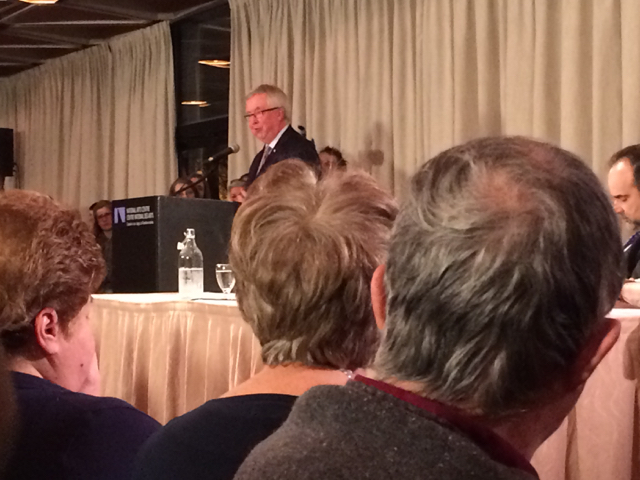
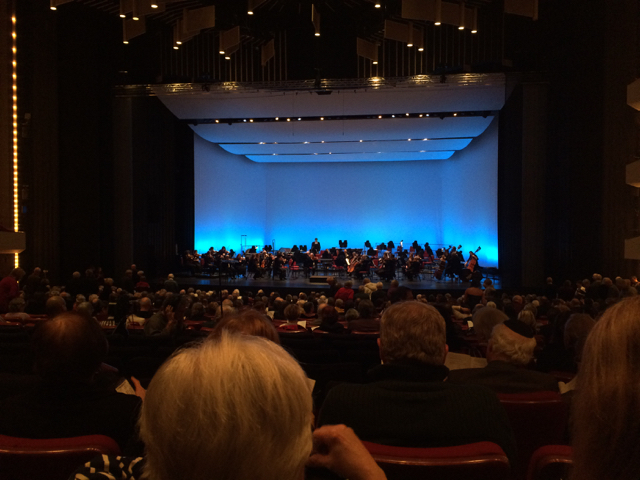 It’s been a while since I’ve done any arts reporting, but this is an exception. Last night I had the good fortune to attend the world premiere of I Lost My Talk, the new original composition commissioned by the family of former Prime Minister Joe Clark as a gift for his 75th birthday. The composition is based on the poem of the same name by Rita Joe, considered the “poet laureate of the Mi’kmaq” people, and it deals with a people losing their language and subsequently culture thanks to the legacy of residential schools. The evening was marked by a talk on Art and Reconciliation, led by Dr. Marie Wilson of the Truth and Reconciliation Commission, followed by the performance of the work itself. Presented along with other works about the endurance of the spirit – Shostakovich’s Symphony No. 9 in E-flat Major, Korngold’s Violin Concerto in D Major, Op.35, and John Williams’ theme from Schindler’s List, I Lost My Talk was the final performance of the evening. It was presented along with a video projection of a dance performance, also created to accompany the work. While one may not be sure how to turn a very tight poem of a few lines into an eighteen minute musical piece that is done without lyrics – lines of the poem recited intermittently through the piece – it was done perfectly. The composition itself was like an epic score to the poem, that was cinematic in scope and feel, the film and the choreography therein were wonderfully realized, and visually arresting. In total, it’s a powerful new work of Canadian composition that takes on the themes of reconciliation, bringing elements of the Indigenous conversation to more European art forms, and creates something powerful of them together. It was stated in the talk beforehand that reconciliation is not an Indigenous problem – it’s a Canadian one, where all of our society needs to participate. This work is part of that conversation, and reconciliation. One can think of no greater gift to a former Prime Minister like Joe Clark than the one that his family commissioned for him with I Lost My Talk. That the National Arts Centre is carrying on and extending the work with more First Nations artists creates a broader dialogue for the work, and the ongoing project or reconciliation.
We asked #Indigenous youth to create a song based on Rita Joe's "I Lost My Talk." Watch: https://t.co/XDToBIjz8O /JC pic.twitter.com/itD13V1Q2D
— National Arts Centre (@CanadasNAC) January 13, 2016
Roundup: Caution on the veto
The particular bugaboos of electoral reform and the role of the Senate have been colliding increasingly in the past number of days, as there have been threats coming that certain Conservative senators have been threatening to use their majority to vote down any legislation on changes to the electoral system unless there’s a referendum first. And then this particular op-ed in the Citizen by a Université de Montréal law professor urging them to do just that makes me want to just take a moment to talk it all through. First, a few things to keep in mind – the senator who went to the media about this threat was Don Plett, who is, well, singular on some issues. He’s broken ranks before, and is willing to stick to his guns on others, but I wouldn’t ever quote him as the voice of the Conservatives in the Senate, even though he is now the caucus whip. The other thing to keep in mind is that the Senate of Canada, being probably the most powerful Upper Chamber in the democratic world, does indeed have the power of unlimited veto – there is no overriding it if the Senate decides that they want something to die. It’s a power that they very rarely use, particularly when it comes to government bills – it’s kind of like the nuclear deterrent for legislation. No, they’d rather make amendments and send it back, with few exceptions. The reason it’s treated with such caution is that they know they don’t have the democratic mandate to exercise these powers except in rare circumstances. In those rare circumstances, they will do it because it’s their job to have a check on a majority government, and be empowered to speak truth to power, which is why they are afforded the kind of institutional independence that they have. So with this in mind, I will hold up a big caution sign when it comes to encouraging them to overturn any theoretical bill on electoral reform. This all dredges up memories of the Free Trade Agreement, and when the Senate held up that bill from the Mulroney government until it could be put to the people, seeing as this deal was hugely contentious at the time, and it was believed that it was going to be selling out our sovereignty to the Americans. The election was fought on this issue, Mulroney won, and the bill passed, and lo and behold, the sky didn’t fall. But while there was merit in putting that question to the people, it was part of the chain of events that started to polarise the Senate, which prior to 1984, was said to have operated on a much less partisan basis. Tit-for-tat games ramped up the partisanship there, until things became so bad that Mulroney exercised the emergency powers of appealing to the Queen to appoint an additional eight senators in order to get the GST passed. The Senate is currently in a vulnerable spot, and while I wouldn’t ask them not to do their jobs because they are in a period of intense scrutiny and this would get blown completely out of proportion by an ignorant pundit class and MPs with agendas harmful to the independence of the Senate – but it would hurt them. That’s why this discussion needs to be approached extremely cautiously, and rash actions scrupulously avoided at all costs.
Roundup: Political drinking
The admission by new Liberal MP Seamus O’Regan that he’s seeking treatment for an “alcohol-free lifestyle” is one that has brought plaudits and expressions of support from across the political spectrum. This is, after all, the age where people are being more open about issues like addiction and mental health, in order to shake the stigma that still surrounds it. But as Laura Payton writes in Maclean’s, this does present a problem with the way that Ottawa works currently, where much of the socialising here revolves around cocktails. Social functions put on by lobby and industry groups are in that 5-7 hour, when MPs come out of votes or committee meetings and head to them for drinks, hors d’oeuvres and schmoozing. It’s pretty much the only bonding experiences that MPs have left, given that the shared experiences of dining together three nights a week before late sitting debates happened were killed off in the early nineties in an attempt to make the institution more “family friendly.” But really, what this misses is the fact that it’s a far less booze-intensive place than it used to be, and I’m not talking about the post-Confederation days when there used to be a pub in the basement of the original Centre Block. No, up until the early nineties, there was far more access to alcohol around the Parliamentary precinct, where there used to be beer machines everywhere (one of the last was in the Press Gallery’s Hot Room), where there used to be the Press Club where reporters and sometimes politicians would drink together at the end of the day, and when martini lunches were a Thing. And those late night debates were often lubricated by drinks with dinner, during an age where you couldn’t order by the glass in the Parliamentary Restaurant, but rather had to buy the whole bottle (which they would put your name on and keep behind the bar for you). So really, if anything, it’s probably the easiest it’s ever been for people who are abstaining to be around the environment. On the other hand, there has been a direct loss in the collegiality between MPs since the booze largely stopped flowing. Make of it what you will, but the relationship between politics and alcohol is an interesting and fairly interconnected one, which makes a story like O’Regan’s a particularly interesting one to consider in the broader context.
Roundup: Demanding immediate parity
It seems that I couldn’t ignore the siren call of the Senate bat-signal one last time. A group of prominent women want the prime minister to ensure that all 22 current vacancies in the Senate be filled with women in order to quickly achieve gender parity in the upper chamber. Trudeau has already stated that he wants to move the chamber toward gender parity and diverse representation as part of the appointment process (and it does have more women and minorities on a proportional basis than the Commons does), but this would be a bit more strident. It’s not a terrible idea, and one doesn’t really want to get into the “merit” debate because there isn’t a shortage of meritorious women that could fill every one of those seats. That’s not the issue. What I worry about is that it sets up a situation where the demand that it be balanced at all times, so as to start setting gendered seats in each province, and that if there is a retirement or resignation, it becomes imperative that the new holder of that seat be of the gender that is required to maintain balance, despite there being other considerations for some of those seats, such as linguistic minorities, Aboriginals, or other minority communities. Where this would especially be problematic is Quebec, where there are senatorial districts, and it could “lock in” the gender of those districts’ senators, despite the fact that some of those districts were initially established to protect other communities. Meanwhile, David Akin penned an utterly facile column that conflates the Duffy trial with the broader problems of the Senate and somehow comes to the conclusion that constitutional Senate reform is the answer, never mind that he offers no actual vision for what that reform is supposed to accomplish, and he may have missed the memo that elected chambers have spending scandals. All. The. Time. Left unsaid is the fact that the Senate has undergone substantial internal reform and tends largely to be more transparent than the Commons, not that it fits within anyone’s narrative of the “grasping, tawdry circus” of the Senate, when on the whole it is anything but. Seriously, pundit class – reality doesn’t quite reflect your tired received wisdom.
https://twitter.com/emmmacfarlane/status/679460774213857280
https://twitter.com/emmmacfarlane/status/679461199080075264
Roundup: Different approaches to transparency
The government announced yesterday that they would be halting compliance measures related to the First Nations Financial Transparency Act, and would restore the funds frozen to those 38 bands that had not reported yet. It was a move that First Nations applauded, while Conservatives and other small-c conservative types decried as making things less accountable. We also found out that the previous government was considering putting those non-compliant bands under third party management, which sounds fairly drastic. It’s not that First Nations are against being accountable – for the most part, they have indicated that they want to be, but that the previous government’s legislation was ham-fisted and in some cases unfair because it forced the reporting of revenue streams that didn’t come from taxpayers. In fact, they have long raised the notion of the creation of a First Nations Auditor General, but the Conservatives were never in favour of it. And to be sure, there are bands that do require a closer eye because in some First Nations, there are problems with nepotism and corruption, and it does need exposure. The question becomes what tools are best able to accomplish the goal that aren’t paternalistic or steeped in racist assumptions. It’s something that the current government is looking to engage with, and we’ll see where their consultations take them, but this will no doubt be part of their move to transform their relationship with Indigenous Canadians.
Roundup: The town hall performance
Justin Trudeau had his townhall with Maclean’s yesterday (in partnership with fellow Rogers publications Chatelaine, L’Actualité and CityTV, of course), and it went very well, and was engaging (and the whole thing can be viewed here). There wasn’t a lot of news, per se, that came out of it, but Trudeau did spend some time explaining certain positions, such as why he thinks there is a better role for Canada in the Middle East that draws from our experience in Afghanistan than the bombing mission does, or why he made the decision to cut the tax bracket that he did (it winds up helping more people when examined in conjunction with the new child benefit program), and the whole issue of the federal minimum wage (it only helps such a small group of people, and wasn’t likely to move too many provincial governments). Oh, and he slammed the kinds of fear-mongering politics engaged in by politicians like Donald Trump as ignorant and irresponsible. John Geddes remarks about Trudeau’s effortless adoption of the role of Prime Minister, while Paul Wells offers his thoughts on the event as the moderator, and how Trudeau compares to Harper. Laura Payton notes the very politic way in which Trudeau responded to questions, and some of the lessons that he perhaps learned from Harper in that regard.