Roundup: A precipitous climbdown

In an attempt to head off a day full of useless circular discussion around the process of the electoral reform discussion, the Liberals offered an epic climbdown and accepted the NDP’s gamed committee configuration, giving up their perfectly legitimate committee control and then patting themselves on the back for looking reasonable for backing down. Trudeau went so far as to say that they felt like they were looking too much like the previous Conservative government, and decided to take a different tone, with all of the usual platitudes about working together and cooperation and so on. Which is a nice sentiment, and they get all of these plaudits for looking reasonable and like grown-ups, but I wonder if they haven’t given up their ability to put their foot down in the future when they need to, lest the process spin out of control, as these things are wont to do. Nevertheless, I will reiterate that this is not any kind of reasonable compromise. In fact, there are a few reactions that sum up my feelings pretty well.

https://twitter.com/inklesspw/status/738384990463918081

https://twitter.com/robert_hiltz/status/738409956865642496

And Hiltz is bang on. The Liberals have walked into the NDP’s trap, and this whole process, already a gong show, has just become an even bigger one. The Conservatives are completely apoplectic with outrage, claiming that there was a “backroom deal” to get this deal (when that really doesn’t seem to be the case if you look at how it was unveiled and how the NDP were just as surprised by it). So while the howls for a referendum will continue, and the bogus “proportional” arguments will ring through the back-patting on this whole sordid affair, I will just reiterate this particular sentiment.

Continue reading

QP: Slightly sharper responses

It was very nearly a full house, and all of the leaders were present and ready to go. Rona Ambrose, mini-lectern on neighbouring desk, led off by concern trolling about the government trying to control the debate — as though her government was blameless on that front. Justin Trudeau rose to respond, noting that sixteen amendments were made to C-14 during the committee stage and that it was a free vote on the bill, while mentioning the deadline. Ambrose then moved onto the first of many demands for a referendum on electoral reform, for which Trudeau gave some standard lines about Canadians demanding change for the system. Ambrose accused the government of trying to rig the process and that they had hired a proponent of ranked ballots, but Trudeau responded with platitudes about a more inclusive process. Denis Lebel was up next to concern troll about Liberal party members being “muzzled” on C-14 debates last weekend, and Trudeau insisted that they had frank discussions including the ministers. Lebel worried about the provinces with C-14, and Trudeau insisted that the bill was largely based on the Quebec model. Thomas Mulcair was up next, and rises the Environment Commissioner’s report on toxic substances not being reported to Health Canada. Trudeau thanked the Commissioner for her report, and said that they would implement her recommendations. Mulcair then moved to a declaration that C-14 was unconstitutional, and Trudeau gave the standard responses. Mulcair demanded that the bill be referred the Supreme Court, but Trudeau reiterated the deadline debate. Mulcair pivoted again and demanded immediate decriminalisation of marijuana, for which Trudeau chided him for his desire to do an end-run around parliamentary process and that decriminalisation wouldn’t keep it out of the hands of children.

Continue reading

Roundup: A curious silence

After a long weekend of seeing waaaay too much social media abuse hurled at Ruth Ellen Brosseau regarding The Elbowing, and both the Liberals and Conservatives coming to her defence, I am struck that no NDP MP has come forward to take any responsibility for the apocalyptic rhetoric they hurled at the Prime Minister on Brosseau’s behalf that she is now being blamed for, even though she didn’t actually say anything other than to acknowledge that yes, she was elbowed. Also, I remain bemused that people continue to muse about Justin Trudeau’s “anger management issues” and temper when it was Thomas Mulcair who exploded into a rage ball as it all happened, which forced MPs around to separate him physically from Trudeau. Also, amusingly, an Ontario newspaper took the Beaverton fake news article about the NDP showing up the day after The Elbowing in wheelchairs and neck braces as being true. So there’s that. Meanwhile, we’ve got a week for tempers to cool and to see if the House Leaders can come up with any kind of schedule regarding the remaining legislation that needs to be passed while ensuring the opposition feels they’ve had enough time to debate the assisted dying bill, while also noting that it looks like Parliament will sit extra late this year as the Senate contemplates those bills with likely amendments, and keeping in mind that President Obama is due to address a joint session of Parliament on June 29th – which is after the June 23rd date that the Commons was supposed to rise for the summer.

Continue reading

QP: Raising the referendum temperature

With the big announcement on the trans rights bill having been made, there were plenty of members’ statements about International Day Against Homophobia and Transphobia. All of the leaders were present, and Rona Ambrose led off, mini-lectern on neighbouring desk, and asked about the review of the forthcoming NEB ruling on the TransMountain Pipeline. Justin Trudeau hit back, saying that it was the previous government that created uncertainty by not committing to protecting the environment. Ambrose insisted that the review was “very thorough,” but Trudeau repeated his response about the previous government’s failings. Ambrose changed to the electoral reform referendum issue, and Trudeau responded with his promise that the last election would be the last under First-Past-the-Post. Denis Lebel took over and asked another pair of demands for a referendum in French, and Trudeau repeated his same answer in French. Thomas Mulcair was up next, and wondered “what the hell” the government was waiting for about decriminalizing marijuana — earning him a rebuke from the Speaker. Trudeau repeated his standard points about legalization as a framework to protect kids and deprive organized crime of revenue. Mulcair switched to French to ask about a pardon for people currently convicted under the existing law, but Trudeau’s answer didn’t change. Mulcair changed to C-10, for which Trudeau insisted that it would be used to build an aerospace industry in Canada. Mulcair repeated the question in English, and got the same response.

Continue reading

Roundup: A short history of trans rights bills

The government is unveiling their promised trans rights bill today, and throughout the day, you’ll be reminded that other trans rights bills have been introduced in the House, and twice died in the Senate, and there will be a general sense of the NDP trying to anoint themselves in this glow of having been the fearless pioneers on this file. And it’s true – they did introduce previous trans rights bills, some of them more successful than others. But there is more to the story than is usually presented, and as someone who used to cover this file extensively (back in my Xtra! and the much lamented Outlooks days), it’s a little more complicated than is often presented. And yes, the NDP have largely introduced iterations of this bill but the sponsor, then-MP Bill Siksay, was too far down the Order of Precedence for it to be ever debated. During the 40th Parliament, however, he was high enough on the Order that the bill came up for debate, and narrowly passed the Commons. By the time it reached the Senate, however, it had mere days before the government was defeated. The Senate has no mechanisms by which to accelerate a private members’ bill, and the justice committee – where it would have been sent to – was jammed full of “tough on crime” bills and a private members’ bill never would have been able to come up for debate (as government bills always take priority). Nevertheless, the Senate was blamed for “ragging the puck” and it died when Parliament dissolved and an election was called. By this time, Siksay had announced that he was not going to run again, and Liberal MP Hedy Fry had said that she would re-introduce the bill in his stead if re-elected. She was, and fulfilled his promise. The NDP’s newly elected MP Randall Garrison was named the party’s new LGBT critic, and he was incensed that Fry had re-introduced the bill and decided to table his own version, but because you can’t have two identical bills on the Order Paper, he needed to come up with some creative drafting in order to differentiate the two bills. And then, by sheer fate, his name came up right before Fry’s on the Order of Precedence when the lottery was drawn, so he went ahead with his poorly drafted bill, while Fry’s version of the same bill was not put forward (and she went on to introduce a cyberbullying bill that was defeated). Not only did Garrison’s bill go ahead, but he decided to introduce amendments that would partially gut the bill and do things like put in definitions for “gender identity” into the text (something that would put it out of step with any other protected grounds in legislation). The resulting bill was a dog’s breakfast, and he managed to squeak it past the Commons, but he actually lost some Conservative support because it was such a hot mess. And when it reached the Senate, there were concerns. Conservative Senator Don Plett had some particular concerns and wanted to raise amendments, and while this whole “bathroom bill” nonsense began circulating, his amendments, while not great, were blown out of proportion by supporters of the bill as being far more odious than they were. And that bill eventually died on the Order Paper when Parliament dissolved, but while the NDP railed against the Senate as “killing” a bill that the Commons passed, they ignored the fact that it was objectively a bad bill and this was more of a mercy killing. And now, we have a government who has committed to making this one of their priorities, and they are, which we should applaud.

Update: The differences between Fry’s and Garrison’s bill weren’t as pronounced as I remember the debate being. Apologies to all involved, and thanks to Justin Ling for the correction. The amendments, however, were a dog’s breakfast.

Continue reading

QP: Endlessly repeating the same question

While it was Monday, the no major leaders in the Commons — Justin Trudeau was several blocks away talking about Canada increasing its contributions to the a Global Fund to fight HIV and TB, while Rona Ambrose was in Alberta, and Thomas Mulcair was, well, elsewhere. Andrew Scheer led off, mini-lectern on desk, asking if the government would match donations to other charities than just the Red Cross in the Fort McMurray wildfires. Ralph Goodale praised the capacity of the Red Cross, and said they would look at other compensation going forward. Scheer then asked why the PM’s in-laws went to Washington and not the Natural Resources Minister. Dominic LeBlanc reminded him that the president himself invited the PM’s mother and in-laws. Scheer lamented that party “bagmen” also squeezed out ministers, and LeBlanc reminded him that the two in question were invited by the White House, and the taxpayers paid no part of their trip. Gérard Deltell then took over in French, asking the same question again twice, and LeBlanc repeated the response in the other official language. Dion responded on the second time, and he praised the work of the Natural Resources minister in getting an agreement with the Americans. Peter Julian led off for the NDP, howling about KPMG’s involvement. Diane Lebouthillier decried those wealthy individuals who haven’t paid their fair share, and that there were criminal investigations underway, contrary to his assertion. Julian asked again in English, Lebouthillier repeated her answer, adding that she isn’t sure why he can’t understand it. Niki Ashton hectored about the size of the budget implementation bill, for which Bill Morneau disputed that it was an omnibus bill. Ashton then demanded immediate decriminalisation of simple possession of marijuana, and Bill Blair quoted Mulcair in saying certain decriminalisation would be a mistake.

Continue reading

Roundup: No appetite for back pay

With parliament resuming this week, all attention is on whether or not Senator Mike Duffy will resume his duties. After all, there have been a few signs of activity in his office, with computers being updated and such, but there remains a question as to whether his health will allow it, but we’ll see. As for the question as to whether he will be getting any back pay for his time suspended without it, well, senior senators are not so keen. In fact, the phrase “no appetite” is continually used, and they are quick to point to the fact that the Senate’s internal discipline – which the suspension was part of – was based on the Deloitte audits and not criminal findings of guilt or innocence, thus his acquittal by the courts makes it largely an irrelevant issue as far as they’re concerned. I would also add that should Duffy decide to press the issue, well, there are a few well-placed senators who around this issue who are known to leak things to the media, and who will undoubtedly start doing so about any other skeletons in Duffy’s closet that they are aware of. Meanwhile, there remain questions back in PEI about whether Duffy remains qualified to represent the province, as there is still a level of distrust that he is actually a resident (and given that it sounds like he spent the bulk of his time on suspension in Ottawa, well, that doesn’t help matters much). Meanwhile, some Conservative senators are grousing a little bit that Senator Peter Harder isn’t really providing much in the way of answers during regular Senate QP (as opposed to ministerial versions thereof). I think they’re being a bit unfair, considering that he’s been on the job only a couple of weeks and hasn’t yet staffed up his office, nor really had a chance to get proper briefings from the Privy Council Office (because yes, he has been sworn into the Privy Council to take on this job, making him a quasi-minister) on the files that he is likely to be asked about, or had much in the way of a briefing binder prepared, but it does put him on notice that they do expect him to step up his game in the role of “government representative,” particularly when it comes to being the conduit for holding the government to account. These are things that are important, especially as there are no opposition voices in the Commons from Atlantic Canada or the GTA, making the Senate’s role in asking those questions all the more important.

Continue reading

Roundup: New paths to power

If there was any particular proof needed that things are indeed changing in the government, the way in which decisions are made is a pretty good place to start, as Susan Delacourt explores over in Policy Options. Gone are the days when all paths lead to the PMO, but rather individual ministers are empowered to make decisions, but at the same time, they are expected to consult with provincial and territorial counterparts. The civil service, having grown used to not being asked to draw up an array of options for shaping policy, is now a “fixer upper,” while the new dynamic makes it possible for anyone to contribute to policy discussions, meaning that the government can draw from a bigger pool of ideas. And the new buzzword of “deliverology” means that goals are being drawn up as tangible things that have knowable results, rather than just abstract dollar figures. (The “guru” of deliverology just met with cabinet at the Kananaskis retreat, where he said that the government has made good progress over the last six months). Commons committees are coming up with policy discussions of their own (not that they’re always going to be taken fully, as the assisted dying legislation shows). We have evidence that the Senate and their legislative agenda is being listened to, with examples like Senator Moore’s bill on restoring parliamentary authority over borrowing being adopted in the government’s budget, and Ralph Goodale talking about how they are considering his bill on CBSA oversight. So yes, it looks like the centre of power is less and less the PMO in this brave new world, which is probably not such a bad thing after all.

Continue reading

Roundup: The verdict as reflection on the institution

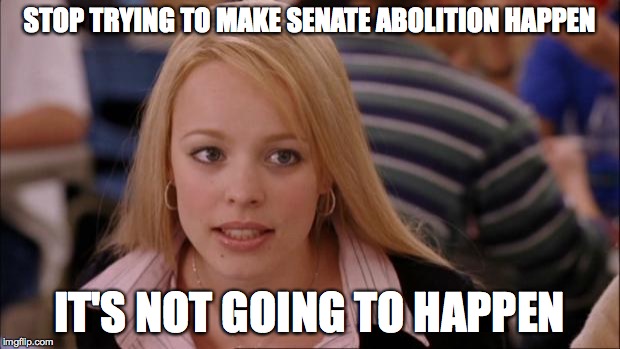
Now that they’ve had a couple of days to digest the events, we’ve got some weekend punditry on the Duffy verdict and What It All Means™ for the Senate as an institution, and well, some of it is really hard to swallow. Rick Anderson has eight thoughts about the expenses issue, and most of them are on the right track, except for number four, which is about the Board of Internal Economy (Commons) and Internal Economy Committee (Senate), and his belief that these bodies are too political to police parliamentarian expenses. The problem with this line of thinking is of course parliamentary privilege – parliament is self-governing. It needs to be. It cannot be brought under the heel of a bureaucracy, because if we can’t trust our parliamentarians to run their own affairs, then we might as well just hand power back to the Queen. Do they get it right all of the time? No, of course not, but this is a democracy and there is an accountability process, and yes, that includes for the Senate. Of course with the Senate, it is much more tied to public pressure, but that public pressure has forced the Senate to make any number of changes in the past few years (they had already started before the whole ClusterDuff affair started, but that certainly accelerated things). This is of course why I have trouble with Adam Dodek’s condemnations of the Senate post-verdict and his (frankly wrong) assertions that nothing has really changed, and his assertion that most senators treat the job as a part-time gig. I’ve known very few senators who feel that way, and most that I’ve met and been in contact with are just as engaged as MPs with their files – even more in many cases when those senators have causes that they are engaged with. The days of senators sitting on a number of corporate boards is drawing to a close as boards are professionalising and the need for a senator as a “prestige” appointment become less common. (I would add that I actually think it’s not a problem for senators to sit on a non-profit board as a way of constituency outreach). And then there’s Michael Den Tandt who retreats to the same old fears about these new independent senators being wholly unaccountable, as though something has materially changed from when they were all in party caucuses (which is false), and that somehow that caucus could keep them more in line (no, not really). Apparently Den Tandt has forgotten that the Senate has institutional independence for a reason, and his musing that the Conservatives should champion abolition by way of a referendum is frankly ridiculous – despite what people may think about a referendum being a tactic to pressure premiers, it returns to the same problem of using majoritarian tactics to pressure minority provinces into giving up their counter-balancing representation. I think I’ll leave this meme here for his edification.

Mean Girls Senate Abolition

Continue reading

QP: Tax credit meanies

While Justin Trudeau was at Gleason gym in Brooklyn, and the Duffy verdict being read out a few blocks away, QP was ramping up for another scintillating session. In the lead up to QP, MPs sang a round of “Happy Birthday” and “God Save the Queen” in honour of Her Majesty’s 90th birthday, followed by a moment of silence for the National Day of Mourning. Rona Ambrose led off, complaining about the demise of the child sport tax credit. Bill Morneau reminded her that the new Child Tax Benefit offers more money for all families to use as they see fit. Ambrose asked again in French, got the same answer, and then moved onto complaining that the Liberals voted down her motion to declare ISIS a genocide. Stéphane Dion reminded her that the official recognition of genocide was serious and should only happen after an international investigation, which is what he was pushing for. Denis Lebel was up next, asking about the aluminium industry in Quebec. David Lemetti reminded him that they are working on the issue. Lebel asked about the issue of diafiltered milk, and Jean-Claude Poissant, responded that they were working on it. Thomas Mulcair was up next, and denounced Bill C-10, refusing to call Marc Garneau by his title. Garneau responded that they were going to rush the bill, which the NDP trie to kill. Mulcair then suggested that it was Carolyn Bennett who let the Catholic Church off the hook for Residential Schools. Bennett listed the dates to prove that it was the previous government, and the government couldn’t force the Church to do anything. Mulcair then changed topics to the Saudi arms deal, at which point Dion repeated Mulcair’s statements on honouring the agreement during the election. Mulcair thundered that the Liberals weren’t defending human rights, and Dion kept reminding Mulcair of his own words on the contract.

Continue reading