
Roundup: Authoritarian theatre, separatist referendum edition

Danielle Smith’s attempt to engineer a separation referendum in Alberta went entirely off the rails yesterday in one of the most cynical yet spectacular ways yesterday. The legislative committee that is supposed to make the determination on the petition process met yesterday, in a somewhat desperate move, to consider the Forever Canada petition, which Smith has been poised to weaponise as her referendum because it wouldn’t require First Nations consultation because it’s framed in the positive of remaining in Canada. Never mind that petition author and former deputy premier Thomas Lukaszuk doesn’t actually want this as a referendum—he wants it to be a vote in the legislature, so that the UCP owns it. Nevertheless, midway through the meeting, the UCP sent out a press release saying that they had agreed to turn this into a referendum, complete with quotes from the chair, when no votes had been taken.

And then all hell broke loose. The UCP sent out a note to disregard the press release, while inside the committee, NDP members were moving points of privilege which will need to be adjudicated by the Speaker of the Assembly. It also turns out that Danielle Smith had booked airtime tonight, so this entirely looks like the fix was in, and that the committee process was merely authoritarian theatre to manufacture consent, so that Smith can continue to placate the separatists in her base. The whole thing is both cowardly on Smith’s part, and just amateurish beyond belief.

Now we know.Smith committed to give separatists a referendum. She pre-recorded her tomorrow’s TV address, before the Legislature committee had a chance to vote on the #ForeverCanadian petition. UCP sent out a press release on a vote that didn’t happen, while they supposedly listened to me#ableg

Hon. Thomas A. Lukaszuk (@lukaszukab.bsky.social) 2026-05-21T00:17:52.059Z

But there is a point to this amateurishness, which Jen Gerson points out here—these people think that they’re strategic geniuses for engineering conservative victories in Alberta, and so they’re overconfident in their abilities. Jason Kenney was, and lo, the leopards he let into the house at his face, while Smith has tied herself into so many knots to try and placate those same leopards in the hope that they won’t eat their face, while they are staring at her and licking their chops, but she insists that she’s the strategic genius here. None of this is going to end well, in part because these are deeply stupid and unserious people, and the country is going to suffer as a result.

Effin' Birds (@effinbirds.com) 2026-05-20T19:08:01.746Z

Ukraine Dispatch

Russian missile, drone and artillery attacks on Dnipro killed two and injured six. Ukraine is bolstering their northern defences over concerns of a planned new attack on Kyiv. Oil refining in central Russia is at a standstill thanks to Ukrainian attacks.
Continue reading

Roundup: Mixed messages about deeper integration

Late last week, prime minister Mark Carney was at the Global Progress Action Summit in Toronto, and gave a speech that seems to be a bit of a Rorschach test about how you feel about him and the job he’s doing. While I believe he’s correct in saying that the loss of control people feel with affordability and the rise of digital asbestos leads to a “politics of grievance,” I am less convinced the same is true for immigration, and that it has proven a reliable scapegoat by everyone, Carney included, which is absolutely dangerous—especially when he uses phrases like “taking back control.” He also says that the current moment has been “seized by politicians who seek to destroy and dismantle and progressives must answer by building,” but he has been eroding and quietly dismantling the actual progressive programmes brought in by his predecessor. The fact that he is calling himself a “progressive” is stretching the definition to its breaking point.

Amidst this, there was another statement that raises even more eyebrows, which is that “Like Mexico, Canada remains open to deeper integration, including options for fortress North America in (certain) sectors. And to be clear, those offers are on the table.” Deeper integration? Fortress North America? So, after all of the talk about how being solely dependent on the US as a single trading partner has been a strategic weakness and that we need to diversify so that we have options and can’t be held hostage, we want to integrate even more closely in strategic sectors with the same country that has been trying to hold us hostage, threatening our sovereignty, and which has taken to bullying us because they think they can get away with it without consequence? I mean, I get that we cannot fully decouple from the US because of geography (and even Taiwan trades mostly with China, because of geography), but this message seems at odds with everything happening, and it’s really hard to see how he can promise this without some pretty heavy caveats up front, and I’m not exactly seeing anything that inspires me with confidence.

Effin' Birds (@effinbirds.com) 2026-05-10T23:08:01.480Z

Ukraine Dispatch

Russia violated the ceasefire by making drone strikes on the front lines, and Ukraine launched a few drones in response. Putin claims the war will be winding down soon, but said they will be victorious, but are even further away from their aims, so we’ll see. Here is a look into the dispute between Ukraine and Israel over shipments of stolen grain, and why Israel is uncomfortably close to Russia.

Continue reading

Roundup: A call to ignore Pathways

In a sit-down interview with The Canadian Press, prime minister Mark Carney says that an oil pipeline out of Alberta is “more likely than not,” and this doesn’t mean the revived Keystone XL (aka “Bridger Pipeline”). But he’s also not saying anything about Pathways, which is a bit suspicious because he tied the approval to Pathways getting underway, and industry has made it very clear they’re not interested in paying for it.

To that end, who showed up in the op-ed pages of the Globe and Mail but Martha Hall Findlay, former Liberal MP and now head of the University of Calgary’s School of Public Policy, who put on a big show to say that she found it hard to write, but lo, she must recommend that the government “pause” Pathways, because it’s useless on a global scale, and “the world changed.” And then there was more hand-wringing and rationalization that Canada is such a small contributor to global emissions that it doesn’t matter.

The world didn’t change. Facts didn’t change. Climate change didn’t stop with the blockade of the Strait of Hormuz, so quite frankly, this is bullshit and special pleading. The notion that we don’t contribute enough to global emissions is such a poor argument because it’s a common action problem. We have some of the highest emissions on a per capita basis, and yes, that matters. Hall Findlay was going on about how this is all about ego, and we just want to look like we’re leaders, but guess what—every action matters. And if you think that it’s too expensive to reduce emissions now, well, it’s going to be even more expensive the longer we push it down the road, when the effects are even more entrenched globally. We’re already spending billions of dollars in insurance payouts every year that are directly related to climate. The vast majority of food price inflation is climate-related, even if people don’t want to admit it. Frankly, these arguments of hers are tired and baseless and not worth listening to, no matter how much she insists she still believes in climate action…eventually.

My favourite moment in any oil price shock cycle is when the Very Serious Energy People explain why this — again! — is not the time to give a shit about the climate crisis

Chris Turner (@theturner.bsky.social) 2026-05-01T15:21:29.234Z

If Canada can make that argument at 1.4% then presumably so can Saudi Arabia (1.5), Iran (1.9) and Japan (2.0).Then I imagine both Indonesia (2.3) and Brazil (2.5) would say, "hey, us too." And at that point, you've ruled out 204 countries accounting for roughly 46% of all national emissions.

Aaron Wherry (@aaronwherry.bsky.social) 2026-05-01T15:02:42.580Z

Effin' Birds (@effinbirds.com) 2026-05-01T19:08:02.330Z

Ukraine Dispatch

Russia launched yet another attack on port infrastructure in Odesa early Friday, and then launched more than 400 drones in a daytime attack that injured ten people in Ternopil in the west. Ukraine is planning an overhaul of its military rotations, particularly after an outcry over images of emaciated soldiers emerged.

Continue reading

Roundup: Boulerice reaches for the exit

Multiple sources have confirmed to multiple news outlets that NDP MP Alexandre Boulerice is about to pull the plug and make the jump to provincial politics, running for Québec Solidaire in the upcoming election. Boulerice is the sole survivor of the 2011 “Orange Wave” that swept Quebec and made inroads into metro Toronto, but in many ways, Boulerice has been a reminder of the party’s failure to capitalise on the gains they made in that election, particularly in Quebec.

The most obvious failure was the party’s inability to cultivate grassroots in the province. Riding associations in most of the province existed on paper only, and they had a habit of running paper candidates for the sole purpose of being able to say they ran candidates in every riding so that they could maximise their spending caps. In the 2011 election, you had a group of McGill students who were placed as paper candidates in several ridings they had never visited, as well as a bar manager from Carleton University, and because of the fluke of Quebec voting emotionally for “Le Bon Jack” after Jack Layton had his bout of cancer and he would wave his cane everywhere, these paper candidates won. But did they do the work of actually building grassroots organisations at this point? Nope. Because the NDP is a party where they consider their federal and provincial wings to be the same organisation, they tend to leave their provincial wings to do the grassroots organising, and well, there isn’t a provincial NDP in Quebec, and so they didn’t, and they paid for it when Quebec’s mood shifted.

The party did try to start up a provincial wing at one point, running candidates in a provincial election, but they failed miserably and got nowhere with it, in part because the NDP didn’t know what it wanted to be in Quebec, where there is already a crowded field that is complicated by federalist, separatist and (ethnic) nationalist convictions, and I seem to recall there was a whole issue of trying to discern just which Quebec NDP MPs were actually separatists. Suffice to say, that provincial failure still wasn’t enough of a lesson for them, and their only anchor in the province was Boulerice, and now he’s leaving. Avi Lewis has ruled himself out of running in that riding (which they will likely lose), and in Beaches—East York once Nate Erskine-Smith steps down in the coming weeks, meaning he is going to make himself irrelevant much the way that Jagmeet Singh did when he won his own leadership contest. If anything, this makes the job of rebuilding the party’s fortunes even harder, and there aren’t enough Zohran Mamdani gimmicks in the world that they can imitate to fix that.

Ukraine Dispatch

A Russian drone attack on Odesa early Friday killed an elderly couple and wounded more than a dozen others. There was a prisoner exchange yesterday, swapping 193 captured personnel on each side. President Zelenskyy was in Saudi Arabia to develop their new security agreement. Here is a look at the problems facing Chernobyl after drone strikes in the area.

Continue reading

Roundup: Moving the majority motion

Government House Leader Steven announced yesterday that he will be moving a motion in the House of Commons today regarding changing the committee make-up for the remainder of this parliament in order to reflect the government’s new majority status, which feels a little bit like jumping the gun. While he does need to give notice of the motion, it won’t be debated until next week sometime at the earliest (because Thursday is a Supply Day for one of the Opposition Parties, and I doubt he would debate this motion on a Friday), but there’s no way the government can vote on it yet. Why? Because the three new MPs haven’t been sworn in yet, and it’s generally a three-to-four-week process for Elections Canada to fully certify the results and report back to the Commons so that the swearing-in can happen, and well, it’s only been a week-and-a-half.

I do find it interesting that they have decided to go the route of adding MPs to the committees to make them twelve members instead of ten, which may be a mistake on the government’s part. Yes, removing a Conservative instead of adding a Liberal to each committee might have seen them howl more, but the things is, we actually barely have enough MPs to go around when it comes to staffing committees properly (remember, this is the reason why official party status is twelve MPs—so that they can have coverage on every standing committee). During Trudeau’s majority parliament, committees were down to ten MPs, which meant that parliamentary secretaries didn’t have to be voting members, which is better for all because they couldn’t essentially be putting their thumbs on the scales on the government’s behalf, but when they were back to minority parliaments, committee memberships went back up to 12 in order to accommodate more opposition members, thus meaning parliamentary secretaries were back to voting members. It looks like Carney and MacKinnon have no problem with this, even though they should—it’s bad form for the independence of committees, but they don’t actually care about that.

It also looks like MacKinnon is doing this now and not later is a power move. I had previously suspected that this move wouldn’t be fully implemented until autumn because the last four sitting weeks before summer would have the committees slammed to get things passed before the break, but now they’re going to mess up their ability to work until the Procedure and House Affairs Committee can produce their report on the new committee memberships because the Conservatives decided to play stupid games on the Ethics committee and force a vote on making François-Philippe Champagne appear before them to answer theatrical questions about his non-existent conflict of interest with the Alto high speed rail project. By pushing this motion and vote to as soon as the government can make it, once the new MPs are sworn-in, it gives them a chance to try and head off the committee before Champagne appears for the sole purpose of having the Conservatives (and probably Bloc) call him corrupt on camera so that they can get clicks on their social media channels. Just ridiculous, and even more ridiculous that MacKinnon has to get in on the dick-swinging in the process.

Effin' Birds (@effinbirds.com) 2026-04-21T19:08:01.767Z

Ukraine Dispatch

Russia claims to have captured 80 settlements and 1700 square kilometres since the start of the year, while Ukraine has recaptured some of that territory back. As Ukraine is about to resume pumping oil through the Druzhba pipeline to Hungary, now that repairs are completed, it looks like Ukrainian drone attacks have reduced Russian oil export capacity by 300,000 to 400,000 barrels per day.

Continue reading

Roundup: Carney’s Forward Guidance

On Sunday morning, prime minister Mark Carney released a ten-minute piece on his YouTube channel called “Forward Guidance,” because he’s still doing his central banker shtick, and it was a direct-to-camera (with three other cameras intercutting) discussion about the place we find ourselves in. Most of this was not new, repeating the same lines from past speeches including the one at Davos, while promising to never sugarcoat things—but he kind of did. I also have to question why this had to be over YouTube and not a speech in the House of Commons, which is why there is allotted time every day for ministers to make statements if they so choose. This could have been done there.

Carney pointed to a “statue” of Isaac Brock that Mike Myers gave him, but by statue he meant two-inch figurine, and that led him to launch into a whole War of 1812 narrative about the people who built this country, which, okay, sure, but you’re not doing much to show you’re not just the second coming of Stephen Harper. When he talked about the building of big things in the post-war period, this is again where things got a bit sugar-coated because there was still complexity to these old projects, and usually practices that would be unacceptable today for good reason. (I also noted that he mentioned universities being built in this period, without mention of the fact that provincial governments are in the process of dismantling our university systems). He also spoke about protecting social programmes (except for letting the funding of a bunch of groups who deliver services lapse), and he mentions pharmacare like it’s not limited to two types of drugs in a handful of provinces. And further sugar-coating was essentially by omission—the fact that so many Canadian businesses have become apathetic to growth or increasing productivity because they have taken the lesson that all they need to do is become rent-seekers.

Predictably, Pierre Poilievre decided he was going to have something to say about this, and that it was all just an illusion because nothing has actually been built yet (because you can build things overnight). He railed about Carney just enriching “well-connected elites,” but Poilievre’s whole scheme is to double down on trickle-down economics, which by definition enriches a small group of elites because the money does not, in fact, trickle down. Melissa Lantsman put out her own rebuttal that included the incredulous and false claim that the Liberals have cost the economy a trillion dollars in the past decade, which is completely fiscally illiterate, but that’s how the Conservatives roll.

Effin' Birds (@effinbirds.com) 2026-04-19T23:08:01.392Z

Ukraine Dispatch

There was a massive overnight attack Saturday on Chernihiv which killed a sixteen-year-old boy, and wounded others. Ukraine is continuing its own drone strikes on Russian oil facilities in Samara, occupied Crimea, and the Baltic Sea.

Continue reading

Roundup: The benefit of the doubt for Gladu

The Liberal convention is happening this weekend in Montreal, and it’s in part a way that prime minister Mark Carney is putting his stamp on the party now that he’s been leader for a year. It’s a different kind of convention—claimed to be the largest policy convention in the party’s history, and there are no American Democrats giving keynote speeches for the party faithful to fangirl over for a change—the keynote was Canadian Rick Hansen, which again, is a marked shift from years past.

Of course, so much of the oxygen is being taken up by the recent floor-crossers, Marilyn Gladu most especially, and while you have news stories talking about a “mixed reaction,” there is nevertheless a sense that pervades the quotes across news stories that delegates are Carney fans, and that they’re giving him the benefit of the doubt for welcoming them into the party, particularly if it gets them to a majority parliament that will being some stability. Chris d’Entremont and Matt Jeneroux have made comments of their own about feeling secure in their decisions, while progressive Liberals like Karina Gould and Stephen Guilbeault are couching their reservations about Gladu into an optimism that she knew what she was signing up for when she crossed over. For her part, Gladu is also talking about how she hopes this move will benefit her riding, though governments aren’t really supposed to favour only ridings they hold (even though it happens, especially provincially).

As for policy, it has been noticed that there isn’t much talk about Trump, even though he continues to dominate the political airwaves and is giving Carney much of his raison d’être for what he’s doing. There are policy resolutions on banning social media for minors, or limiting use of chatbots (but nobody seems to understand the massive problems associated with age verification).

Ukraine Dispatch

President Zelenskyy says that they are facing pressure both military as spring arrives, but also diplomatically as allies want them to stop hitting Russian oil and gas facilities as prices are so high. Farmers in Ukraine are now being hit by high fertilizer prices thanks to the Iran conflict.

Continue reading

Roundup: Trying to deflect on forced labour

There was a lot of talk about newly-minted Liberal MP Michael Ma’s performance at the industry committee, where he questioned a witness about whether she had personally witnessed forced labour in China, in a tactic to try and dismiss her in favour of a witness who was pro-trade in Chinese EVs. Ma later apologised, and there was apparently some confusion over just which region in China he was referring to, but still, it made for a poor clip from committee (and of the CBC reporter chasing him on the Hill), and bad clips would seem to be a cardinal sin in Parliament these days.

This being said, there would seem to me to be a tension in all of this that very few people want to actually discuss, which is the fact that Carney’s “strategic partnerships” that he’s been patting himself on the back for post-Davos speech involve countries that involve forced labour—China and Qatar—while at the same time praising all of the “good, union jobs” that those partnerships will create back home in Canada. This while the Liberals still insist that they opposed forced labour in all of its forms, and that they have strong rules about eliminated forced labour from supply chains. There is a fundamental disconnect that they seem incapable of bridging coherently, because they simply ignore the dissonance, or in Ma’s case, his attempt to throw confusion around it just wound up making him look like an ass.

This is why I wrote my column earlier in the week about the Canadian Ombud for Responsible Enterprise, whose office was designed to look for forced labour in supply chains and call it out, and the fact that Carney has left the office vacant for the past year and will almost certainly smother it in its sleep and scrap the office in the name of budget cuts—so that there is no embarrassment caused over these “strategic partnerships” with forced-labour countries in the name of being “pragmatic” in the post-rupture world of global trade. Ma just gave the government a black eye over this, so we’ll see if they can handle themselves any better in the face of these embarrassing contradictions.

Ukraine Dispatch

Russia claims to have taken a village in eastern Ukraine, while Ukraine reclaimed a village in the Dnipropetrovsk region. President Zelenskyy arrived for an unannounced visit to Saudi Arabia, one of the countries Ukraine is supplying drone expertise.

Continue reading

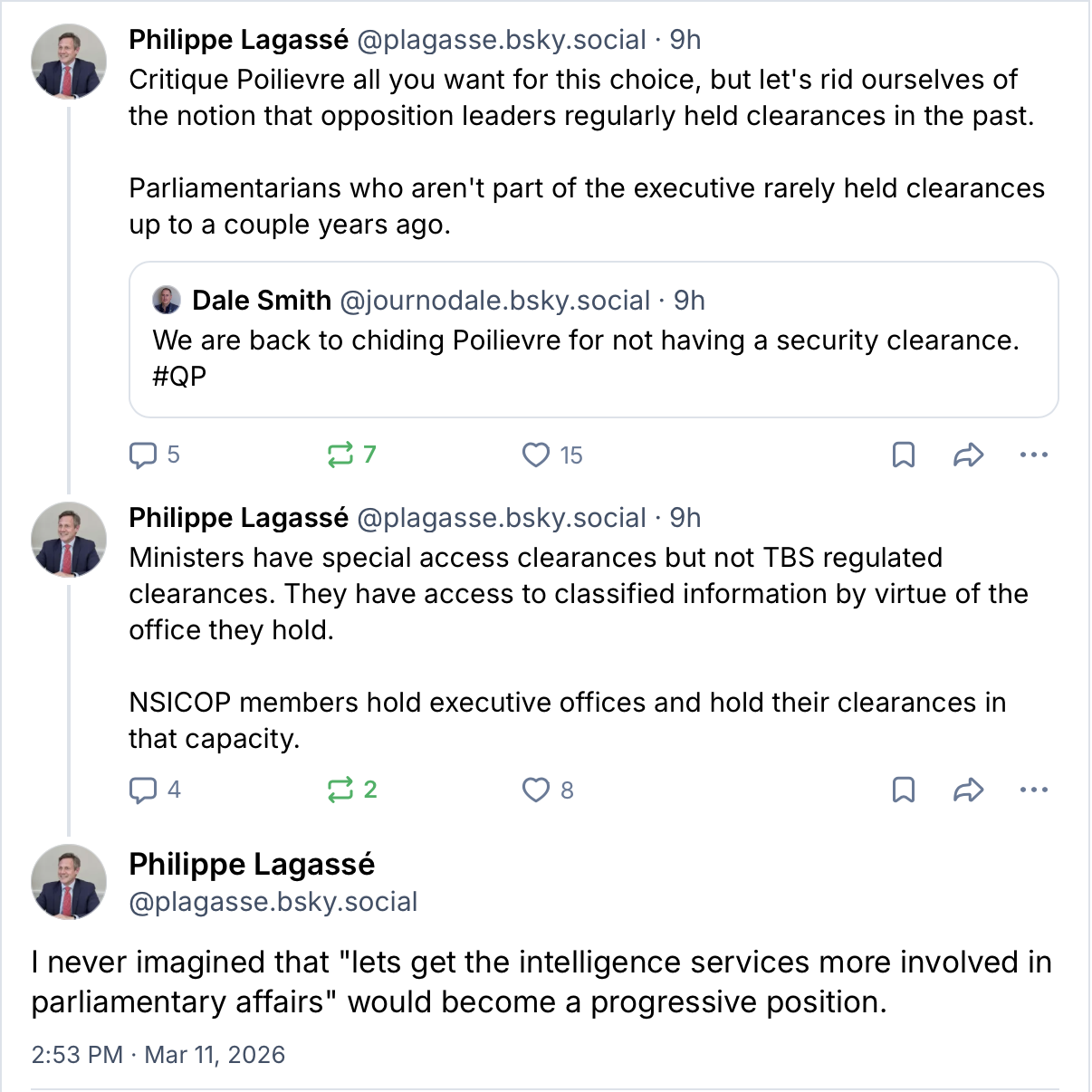
Roundup: Return of the security clearance punchline

Pierre Poilievre’s lack of a security clearance is becoming a punchline in Question Period once more, which is not really great. In the current context, it’s around the claims that there are some 700 Iranian agents in the country, a figure compiled by a civil society group in 2023, before the IRGC was listed as a terrorist entity, and included people in the country temporarily at the time, but far be it for Poilievre to include any context when he’s trying to stir up a moral panic. We should remember, however, that this is not something that opposition leaders routinely applied for, nor is it something that all MPs need.

There were a bunch of people in my social media replies claiming nonsense like daycare workers needing a clearance when MPs don’t. No. Daycare workers need to undergo background checks. They don’t need access to classified materials, nor do the vast majority of MPs (though there is a place for a group of MPs to be cleared for certain oversight activities). This conflation of what a clearance actually means is not helpful to anyone, and while I know that people like to claim that Poilievre can’t get one and is therefore some kind of security risk, that is also false and is actually disinformation.

Throughout this, prime minister Mark Carney did not help matters by dodging the questions from reporters on Indian foreign interference and transnational repression by saying that his security clearance precluded him from saying anything. Aside from the fact that this is false, it just provided fuel for Poilievre’s bullshit claims that he would be “muzzled.” The only thing that he would be muzzled about is making wildly irresponsible remarks in order to drum up outrage. Knowledge means being more circumspect in his claims, which he doesn’t want. He wants to say bold, dumb things in the House and in the media, because it gets clicks and attention. Clare Blackwood explained it perfectly here.

Because Poilievre's security clearance is once again back as an applause line in #QP, here is @clareblackwood.bsky.social to accurately explain why Poilievre won't get his.

Dale Smith (@journodale.bsky.social) 2026-03-11T21:35:30.234Z

Ukraine Dispatch

A Russian drone strike hit a civilian business in Kharkiv, killing two. Ukrainian military trainers will start preparing Germany to defend against Russian attacks by 2029, reversing the trend of western militaries training Ukraine’s.

Continue reading

Roundup: Davos speech vs Iran support

In the early hours of Saturday morning, the Americans and Israelis stuck Iran under dubious pretences—later confirming that nuclear talks were merely a ruse, and that Trump and Netanyahu had been planning this for weeks—and managed to effectively decapitate the country’s leadership, including killing Ayatollah Khomeini. Within hours, prime minister Mark Carney sent out a statement from his trip in Mumbai, where he effectively supported the actions, but also did not promise any Canadian support, military or otherwise. Nevertheless, everyone went on a big round of hand-wringing about how this statement jived with his big Davos speech.

My statement on Iran-related hostilities in the Middle East:

Mark Carney (@mark-carney.bsky.social) 2026-02-28T12:31:32.929Z

It's not small-dick energy.It's smallest dick energy.

Dale Smith (@journodale.bsky.social) 2026-02-28T19:10:15.695Z

Of course, the thing about the Davos speech is that it was a bit of a Rorschach test, depending on one’s priors. Sure, Carney talked about sovereignty and territorial integrity, but he also made it clear that the existing system of international law was a mirage, so he was kind of saying that it didn’t matter? In either case, I don’t think we should expect anything other than “pragmatism” without much in the way of principle, because that is the tone Carney has been setting for a while now, which could eventually work to our detriment.

People keep saying that this goes against the Davis speech. It does not. Carney said the rules based international order was always hypocritical, is now dead, and we live in a time of rupture. I disagree with support but this is not against what he said. The sign is gone. GONE GONE.

Stephanie Carvin (@stephaniecarvin.bsky.social) 2026-02-28T14:54:02.726Z

In Davos, Carney argued that only countries w/ strong economies could afford “principled” foreign policies. Carney’s pro-US, pro-illegal war statement is that idea in action.The thing is, this view is both self-serving and wrong. Wrong because there is always a cost to standing up for principles.

Blayne Haggart (@bhaggart.bsky.social) 2026-02-28T14:14:37.709Z

But if you always subordinate principles (i.e., non-economic interests like international law) to economic growth, you’ll never stand for anything. ESPECIALLY Canada, since the best we can hope for is only sending HALF of our exports to the US. They will ALWAYS have leverage over us.

Blayne Haggart (@bhaggart.bsky.social) 2026-02-28T14:14:37.711Z

In reaction, Bob Rae wonders what happens after the military operation ends, which has long been the question for those who want to attack Iran. Anne Applebaum lays out the fact that Trump has no plans for what to do next with Iran, and has already dismantled programmes which might have helped, which is a huge danger of creating something worse. Justin Ling wonders why Carney chose the route he did of cheering on such a dangerous gambit.

Effin' Birds (@effinbirds.com) 2026-02-28T22:10:01.821Z

Ukraine Dispatch

Zelenskyy’s chief of staff says that Russia has accepted the proposal for post-war security guarantees (which…means not much).

Continue reading