QP: Demanding details of a deal not done

Another busy day on the hill, and while Trudeau had been in the Commons first thing to make another statement on the Fort McMurray situation, he was back for more as QP got underway. Rona Ambrose led off, mini-lectern on neighbouring desk, and asked for reassurance that infrastructure funding to rebuild Fort McMurray would be top priority. Trudeau assured her that yes, this was indeed a priority. Ambrose read the exact same question again in French, got the same answer, and then asked about the details for a bailout for Bombardier. Trudeau reminded her that the negotiations were ongoing, and that they expected a strong long-term business case. Denis Lebel then repeated the question in French, got the same answer, and for his final question, Lebel demanded that they government allow the Billy Bishop airport expand to let Porter also buy C-Series jets. Trudeau responded that they were not going to re-open the tripartite agreement around the Toronto waterfront. Thomas Mulcair was up next, and demanded criminal prosecutions for KPMG tax havens, and Trudeau reminded him that they were working to combat tax evasion. Mulcair repeated the question, got the same answer, before Mulcair moved onto the Canada Post review and not immediately restoring home mail delivery. Trudeau said that they committed to studying the issue and understanding how to give Canadians a better level of service. Mulcair asked the same again in English, skirting the rules around the use of the word “lying” in the chamber. Trudeau reiterated that they were putting in the time that the previous government didn’t in order to ensure Canadians got the right level of delivery.

Continue reading

Roundup: A pointless procedural dust-up

The shine has come off around the medical assistance in dying bill, as the government decided that enough was enough, and it was time to send it to committee. So they invoked time allocation, and not surprisingly, there was all manner of outcry about how terrible this was, and Conservatives like Jason Kenney equivocating, insisting that they never employed time allocation on such sensitive life and death matters as this (ignoring things like safe injection sites or laws around prostitution as also being life and death matters for those that it affects). Kenney’s later assertions about what this bill will do were also…fanciful to say the least.

https://twitter.com/dgardner/status/727954797190479872

I will say that I have little sympathy for MPs who railed about the government cutting off debate, after two nights of midnight sittings and over 84 MPs having spoken to the bill. This is second reading debate, which is the principle of the bill. And I’ve listened to enough speeches to know that they all basically say “this is a very personal issue,” and “What about palliative care?” with minor variations throughout. The concern trolling about the conscience rights of doctors is also in there, never mind that this is a bill dealing with the criminal code and that issue is one for the provinces who deliver healthcare and the provincial certification bodies for physicians. There remains committee stage debate – which is the real meat of the bill – report stage once it comes back, and third reading debate. If MPs still have things to say, there remain plenty of opportunities, and the government also pointed out that some MPs had been up to speak several times on the bill, meaning that there couldn’t possibly be that many more MPs who needed to speak. And if you’ll forgive my particular cynicism, how many more times do we need to hear MPs read those same sentiments in the record over and over again? The government was already generous in the amount of time it gave to debate second reading – accusing them of somehow stifling debate or invoking closure were both patently wrong and false. And so, once all of the procedural wrangling and grousing was done, it passed second reading by a wide margin. Liberal MP Robbie Falcon-Outlette was the sole member of that party to vote against, and he went on Power & Politics to make a bunch of patently false equivalences between this bill and the suicide crisis in places like Attawapiskat, with a host of intellectually dishonest arguments strewn along the way. The bill also began pre-study in the Senate, where I expect it will get a much tougher ride, and there remains a very real chance that even if the bill passes the Commons unscathed that it will not do so in the Senate, and that it may not pass by deadline.

https://twitter.com/cmathen/status/727990740576403456

Continue reading

Roundup: The verdict as reflection on the institution

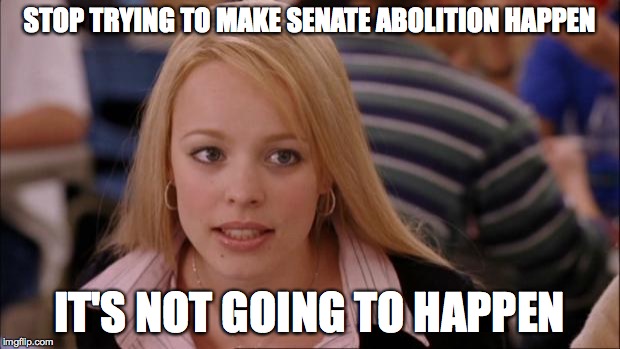
Now that they’ve had a couple of days to digest the events, we’ve got some weekend punditry on the Duffy verdict and What It All Means™ for the Senate as an institution, and well, some of it is really hard to swallow. Rick Anderson has eight thoughts about the expenses issue, and most of them are on the right track, except for number four, which is about the Board of Internal Economy (Commons) and Internal Economy Committee (Senate), and his belief that these bodies are too political to police parliamentarian expenses. The problem with this line of thinking is of course parliamentary privilege – parliament is self-governing. It needs to be. It cannot be brought under the heel of a bureaucracy, because if we can’t trust our parliamentarians to run their own affairs, then we might as well just hand power back to the Queen. Do they get it right all of the time? No, of course not, but this is a democracy and there is an accountability process, and yes, that includes for the Senate. Of course with the Senate, it is much more tied to public pressure, but that public pressure has forced the Senate to make any number of changes in the past few years (they had already started before the whole ClusterDuff affair started, but that certainly accelerated things). This is of course why I have trouble with Adam Dodek’s condemnations of the Senate post-verdict and his (frankly wrong) assertions that nothing has really changed, and his assertion that most senators treat the job as a part-time gig. I’ve known very few senators who feel that way, and most that I’ve met and been in contact with are just as engaged as MPs with their files – even more in many cases when those senators have causes that they are engaged with. The days of senators sitting on a number of corporate boards is drawing to a close as boards are professionalising and the need for a senator as a “prestige” appointment become less common. (I would add that I actually think it’s not a problem for senators to sit on a non-profit board as a way of constituency outreach). And then there’s Michael Den Tandt who retreats to the same old fears about these new independent senators being wholly unaccountable, as though something has materially changed from when they were all in party caucuses (which is false), and that somehow that caucus could keep them more in line (no, not really). Apparently Den Tandt has forgotten that the Senate has institutional independence for a reason, and his musing that the Conservatives should champion abolition by way of a referendum is frankly ridiculous – despite what people may think about a referendum being a tactic to pressure premiers, it returns to the same problem of using majoritarian tactics to pressure minority provinces into giving up their counter-balancing representation. I think I’ll leave this meme here for his edification.

Mean Girls Senate Abolition

Continue reading

Senate QP: Garneau in the hot seat

It was the first ministerial Senate QP with the advent of Peter Harder’s arrival as “government representative,” so it remained to be seen how this would change things. Senator Carignan started off, asking about rail safety, and more specifically around high-risk crossings. Garneau first thanked the senators for inviting him, before responding that the risk crossing database was a tool used by the department for investigative purposes and he was meeting with the Federation of Municipalities in a couple of weeks. Carignan asked further about the database, and Garneau explained some of the risk assessment measures related to it.

Continue reading

QP: Déjà vu from Monday

While new senators were being sworn in down the hall, all of the leaders were present for QP in the Commons, and everyone was raring to go. Rona Ambrose led off, reading from her mini-lectern, asking about how the budget numbers don’t add up. Justin Trudeau stated, matter-of-factly that they were putting money in Canadians’ pockets. Ambrose listed people who felt the budget lacked transparent, but Trudeau was undaunted in lauding the good news of the budget. Ambrose accused him of blocking projects like pipelines, and Trudeau hit back a little more pointedly about how “shouting pipelines into existence” didn’t work. Denis Lebel was up next, worried that the infrastructure envelope was thin, and Trudeau lauded the funding. Lebel launched a paean about how great the infrastructure funding was under their government, but Trudeau reminded him that their arguments failed to convince Canadians in the fall. Thomas Mulcair was up next, and got an ovation from the whole of the Commons. He repeated the false equivalency of that Shelly Glover fundraiser with the Jody Wilson-Raybould fundraiser, to which Trudeau listed all of the rules and said that they were being followed. Mulcair switched to the Panama Papers and the story that CRA officials went to work for KPMG, and Trudeau recalled the new funds for CRA in the budget. Mulcair repeated a bunch of dubious accusations and demanded an investigation into KPMG, and Trudeau repeated the funds for CRA. Mulcair closed the round with a question on EI reform, and Trudeau listed the reforms made so far.

Continue reading

QP: Easter Theatre

It was Friday-on-a-Thursday QP in the Commons, in advance of the two-week Easter break. Justin Trudeau was away, as were many ministers, starting to fan out across the country to sell the budget to Canadians, but Bill Morneau was present, and expects to be the star of the show. Rona Ambrose led off, mini-lectern on neighbouring desk, and she railed about the “betrayal” of the middle class. Morneau insisted that there were plenty of measures to help families. Ambrose bemoaned the size of the deficit, and Morneau returned with a dig about the previous decade of low growth. Ambrose asked which taxes the government planned to raise, but Morneau didn’t bite, praising the measures therein instead. Denis Lebel took over, lamenting the lack of a plan to balance the budget. Morneau praised the plan to grow the middle class. Lebel closed by repeating the question on the size of the deficit, but got the same response. Thomas Mulcair was up next, recalling Air Canada breaking the law regarding their maintenance contracts, and now the government was retroactively changing that law. Marc Garneau responded that the situation had evolved, and Air Canada had made new commitments to create new jobs in Quebec and Manitoba. Mulcair read some condemnation that the deal was “Orwellian,” and that the Liberals were letting the rich get off the hook, but Garneau repeated his answer about changing situations and competitiveness. Mulcair thundered about the government not respecting a Human Rights Tribunal on equal investment for First Nations children. Carolyn Bennett said that they were making investments, but the systems had to change as well. Mulcair then failed about a plan to outsource Shared Services jobs, but Judy Foote responded that the publicized report was from 2014, which they did not intend to follow.

Continue reading

Roundup: A surprisingly packed budget

And that was the budget. It was full of interesting things, but you wouldn’t know it based on the fact that absolutely everybody was fixated on the deficit figure, and barely even that it was built on a super cautious, pessimistic framework that basically presented a worst-case scenario in terms of assumptions, meaning that the only place it really could go was up, and yes, if the economy grows enough, then the budget will start to balance itself. The child benefit changes are the big news, and as for reaction, the Conservatives call the budget a “nightmare” while the NDP rail about all of the promises that it didn’t keep (because everything should have happened immediately).

Continue reading

Roundup: Revolving door alarmism

Oh noes! Civil servants take positions in ministers’ offices! How terribly partisan of them! Yes, it’s time for another head-shaking column from some of our more alarmist media friends, bemoaning sweetheart deals and revolving doors, but as usual, it lacks all pretence of nuance or much in the way of a reality check on the way things work. I find it mystifying that someone would rather have a twenty-something fresh out of university, whose only real qualification is loyalty to the PMO, filling those ministerial office positions rather than professionals with years of experience in the department. Because while yes, some civil servants went to work in ministers’ offices in the Conservative years, there were a lot of these twenty-somethings on power trips, trying to play power games with departmental officials, which one presumes that people who have civil service careers would be less likely to do. And yes, they get good salaries in those positions, but they’re also a) quite ephemeral given the nature of party politics, and b) enormously stressful jobs that have some people working eighteen-hour days, and they should be compensated for it. And the “revolving door” back to the civil service afterward? Again one asks why they shouldn’t be able to translate government experience into the civil service, particularly if they’ve gained some policy expertise? So long as they perform their duties in a neutral fashion once back in the civil service, I’m not seeing why this is a problem. We need good people doing public service in this country, and we have already set up so many barriers that make recruitment a real challenge for anyone not being bridged in from school, and the growing list of restrictions makes work in ministerial offices increasingly unattractive because their post-political opportunities have become increasingly limited. If we’re not careful, all of our political staffers will be twenty-somethings trying to get experience rather than established people of substance, and I’m not sure that’s a situation that anyone relishes.

Continue reading

Roundup: De-Canadianizing the Crown

A decision from the Quebec Superior Court came down yesterday which will have grave constitutional implications for Canada, yet few people actually know or understand it. The case challenged the royal succession law that the previous government passed as part of the series of reforms passed in all of the realms that share Queen Elizabeth II as their respective monarch, and by most reckonings, the Canadian law was a complete sham, simply assenting to UK legislation, in essence subordinating the Canadian Crown to a subset of the UK crown, despite the fact that they became separate entities after the Statute of Westminster in 1931. The Quebec Superior Court, however, sided with the Department of Justice, that the monarch was the same per the preamble of the constitution as opposed to a separate legal entity, and essentially reducing Canada back to a subordinate British colony, all because the Harper government didn’t want to go through the necessary steps of doing a proper constitutional amendment to change the Office of the Queen to match the aims of reform. So long, Queen of Canada. We hardly knew you.

https://twitter.com/pmlagasse/status/699675727185256448

https://twitter.com/pmlagasse/status/699676140714258434

https://twitter.com/pmlagasse/status/699677275999113218

https://twitter.com/pmlagasse/status/699678028784410624

https://twitter.com/pmlagasse/status/699678843540545536

https://twitter.com/pmlagasse/status/699678990441848832

https://twitter.com/pmlagasse/status/699686628005179392

https://twitter.com/pmlagasse/status/699686740714463234

https://twitter.com/pmlagasse/status/699686958084288512

https://twitter.com/pmlagasse/status/699687878658494465

https://twitter.com/pmlagasse/status/699689056171597824

https://twitter.com/pmlagasse/status/699689344253173761

https://twitter.com/pmlagasse/status/699691519066947588

https://twitter.com/pmlagasse/status/699691722750742529

https://twitter.com/pmlagasse/status/699811121620889600

Continue reading

Roundup: Making adjustments on the fly

Lots of developments in the Senate, so let’s get to it, shall we? Kady O’Malley looks into the ways that the Senate is going through the process of reshaping itself to fit the new reality that they find themselves in, and so far they’ve been doing it in a fair-minded way, tempering some the partisan excesses of the previous parliament while they start adjusting their rules around things like Question Period in the new scheme they’ve developed. I’m still a little hesitant, considering that they’re losing some of the pacing and ability to make exchanges that made Senate QP such a refreshing change from Commons QP, but we’ll see once they start working out the kinks. Meanwhile, the Senate is trying to adapt its Conflict of Interest committee to a reality where there are no “government” senators, and more debate about how to include the growing number of independent senators into that structure. We’ll see how the debate unfolds in the next week, but this is something they are cognisant about needing to tackle, just as they are with how to better accommodate independent MPs with committee selection as a whole. Also, the Senate Speaker has ruled that the lack of a Leader of the Government in the Senate does not constitute a prima facia breach of privilege, convinced by the argument that the lack of a government leader doesn’t affect the Senate’s core ability to review and amend legislation, and that the primary role of the chamber isn’t to hold government to account. I would probably argue that it may not be the primary role, but it is a role nevertheless, but perhaps I’m not qualified enough to say whether that still constitutes an actual breach of privilege, as opposed to just making the whole exercise damned inconvenient and leading to a great number of unintended consequences as they venture into this brave new world of unencumbered independence. At this stage, however, things are all still up in the air, and nothing has really crashed down yet, but it’s a bit yet. By the time that Parliament rises for the summer, we’ll see if all of those broken eggs wound up making a cake, or if we just wind up with a mess.

Continue reading