Roundup: Cauliflower concerns

The NDP put out a press release yesterday, which was essentially an object lesson in precisely what not to do when trying to make hay out of a political issue. The issue – rising food prices, and in particular, the rising cost of fruits and vegetables, and the lament that cauliflower is now a “luxury item.” Err, except that it’s not. And worse, that its “inexplicable” rise in price is entirely explicable – there’s a drought in California, and then there was a frost, which reduced the supply, and the increased demand lately (because it’s a trendy food right now) means that, thanks to the basic laws of supply and demand, the price spiked for a few weeks. And lo, it’s come back down again. And let us not forget that fresh fruits and vegetables in the winter is actually a luxury that our parents pretty much never had. They attempted to use the release to highlight inequality – Mulcair put out a release a couple of days previous, lamenting that Trudeau didn’t bring up inequality during his speech at Davos – but most of the claims in the cauliflower release were spurious. Transportation costs are not increasing – the crashing price of oil means that the cost of fuel is coming down by quite a lot. And the lament that the December rate of inflation was 1.6 percent? Um, target inflation is two percent, so unless they have another target in mind, that might be a policy they want to put out there. Rising food costs also have a lot to do with the lower dollar, and if memory serves, the NDP were lamenting that the dollar was too high (no doubt because they felt it was depressing the manufacturing sector, never mind that there are deeper structural issues than just the dollar alone), and that’s the thing about a low dollar – that it reduces your purchasing power, particularly if the fresh fruits and vegetables that don’t grow in this country in the winter have to be imported. To cap it off, the release offers no actual suggestions for what they’d like to see – only a vague statement that the upcoming budget is an opportunity to do something about inequality. So what, pray tell, is up for offer? Socialist wealth redistribution? The government is already raising taxes on the wealthiest one percent and offering more transfers to poorer families. So in totality, one has to ask if there as any adult supervision in putting out this hot mess of a press release, because the evidence before us makes that assertion unlikely in the extreme.

Continue reading

Roundup: I Lost My Talk

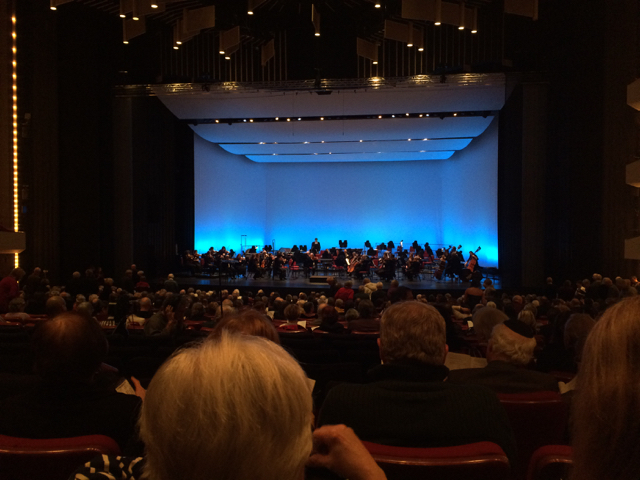
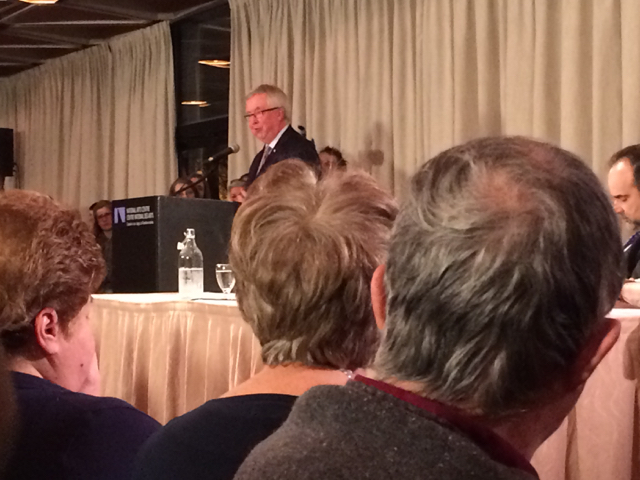
I Lost My Talk performanceIt’s been a while since I’ve done any arts reporting, but this is an exception. Last night I had the good fortune to attend the world premiere of I Lost My Talk, the new original composition commissioned by the family of former Prime Minister Joe Clark as a gift for his 75th birthday. The composition is based on the poem of the same name by Rita Joe, considered the “poet laureate of the Mi’kmaq” people, and it deals with a people losing their language and subsequently culture thanks to the legacy of residential schools. The evening was marked by a talk on Art and Reconciliation, led by Dr. Marie Wilson of the Truth and Reconciliation Commission, followed by the performance of the work itself. Presented along with other works about the endurance of the spirit – Shostakovich’s Symphony No. 9 in E-flat Major, Korngold’s Violin Concerto in D Major, Op.35, and John Williams’ theme from Schindler’s List, I Lost My Talk was the final performance of the evening. It was presented along with a video projection of a dance performance, also created to accompany the work. While one may not be sure how to turn a very tight poem of a few lines into an eighteen minute musical piece that is done without lyrics – lines of the poem recited intermittently through the piece – it was done perfectly. The composition itself was like an epic score to the poem, that was cinematic in scope and feel, the film and the choreography therein were wonderfully realized, and visually arresting. In total, it’s a powerful new work of Canadian composition that takes on the themes of reconciliation, bringing elements of the Indigenous conversation to more European art forms, and creates something powerful of them together. It was stated in the talk beforehand that reconciliation is not an Indigenous problem – it’s a Canadian one, where all of our society needs to participate. This work is part of that conversation, and reconciliation. One can think of no greater gift to a former Prime Minister like Joe Clark than the one that his family commissioned for him with I Lost My Talk. That the National Arts Centre is carrying on and extending the work with more First Nations artists creates a broader dialogue for the work, and the ongoing project or reconciliation.

Joe Clark – Art & Reconciliation Panel

Continue reading

Roundup: Barton in charge

The announcement came down yesterday making it all official – Rosemary Barton has now passed the gauntlet of the competition process and has officially been named the permanent host of CBC’s Power & Politics. It’s not as though she didn’t more than prove herself in spades over the course of the election, with six-days-a-week broadcasts, and sharp coverage, but that Chris Alexander interview, where she shut down one of his tantrums and put him in his place – that has become legendary in political circles already. A senior journalist in this town described her as an “accountability interviewer,” and that’s something that’s been desperately needed in this city, where there has been a certain amount of timidity in the kinds of interviews we’ve seen. Not having a Jeremy Paxman of our own, we’d seen many a political show host in this country tiptoe around members of the Harper government for close to a decade because they often threatened (or instituted) boycotts after one hissy fit or another (John Baird being particularly famous for them), but Barton was having none of that – and it went for opposition MPs as well, like her interview with Thomas Mulcair pretty much on the day she was given the interim job when Evan Soloman’s sudden firing happened, and she didn’t put up with Mulcair’s too-cute-by-half routine. In their release, CBC pointed out her history as a reporter, going back to her starting out as a researcher for the French-language RDI while in Winnipeg, and covering politics in Quebec City – the kinds of chops that her predecessor never had, who relied instead on personality than on hard-won experience in covering the beat. And with Barton’s permanent appointment comes the acknowledgement of the changing face of politics in Canada – the fact that she’s not a middle-aged white male is important in an age of younger MPs, and of gender-equal cabinets, that a younger woman is tougher and more competent in the role than her middle-aged male contemporaries. It’s just too bad that this announcement didn’t happen in June on the heels of Solomon’s departure. (And as for Evan Solomon, it was announced that he’s taking over the afternoon broadcast for Ottawa’s CFRA radio station, because all is apparently forgiven for his ethical lapses).

Continue reading

Roundup: Political drinking

The admission by new Liberal MP Seamus O’Regan that he’s seeking treatment for an “alcohol-free lifestyle” is one that has brought plaudits and expressions of support from across the political spectrum. This is, after all, the age where people are being more open about issues like addiction and mental health, in order to shake the stigma that still surrounds it. But as Laura Payton writes in Maclean’s, this does present a problem with the way that Ottawa works currently, where much of the socialising here revolves around cocktails. Social functions put on by lobby and industry groups are in that 5-7 hour, when MPs come out of votes or committee meetings and head to them for drinks, hors d’oeuvres and schmoozing. It’s pretty much the only bonding experiences that MPs have left, given that the shared experiences of dining together three nights a week before late sitting debates happened were killed off in the early nineties in an attempt to make the institution more “family friendly.” But really, what this misses is the fact that it’s a far less booze-intensive place than it used to be, and I’m not talking about the post-Confederation days when there used to be a pub in the basement of the original Centre Block. No, up until the early nineties, there was far more access to alcohol around the Parliamentary precinct, where there used to be beer machines everywhere (one of the last was in the Press Gallery’s Hot Room), where there used to be the Press Club where reporters and sometimes politicians would drink together at the end of the day, and when martini lunches were a Thing. And those late night debates were often lubricated by drinks with dinner, during an age where you couldn’t order by the glass in the Parliamentary Restaurant, but rather had to buy the whole bottle (which they would put your name on and keep behind the bar for you). So really, if anything, it’s probably the easiest it’s ever been for people who are abstaining to be around the environment. On the other hand, there has been a direct loss in the collegiality between MPs since the booze largely stopped flowing. Make of it what you will, but the relationship between politics and alcohol is an interesting and fairly interconnected one, which makes a story like O’Regan’s a particularly interesting one to consider in the broader context.

Continue reading

Roundup: Unrest without modernization

Oh, look – it’s the Senate bat-signal, shining one last time for me this year. Here we go: Senators Greene and Massicotte, who have been trying to organise some internal reforms to the Chamber, are warning that if modernisations don’t happen within the caucuses that they may see more defections from frustrated Senators, and swelling the ranks of Independents – particularly relevant with more senators on the way chosen by this new process (though nothing says that all of these new senators will sit as Independents, or that they won’t opt to sit in one of the two existing caucuses). Many of the reforms that the two are proposing are pretty modest – electing chairs and vice-chairs of standing committees, replacing Question Period with “Issues Period,” electing caucus officers, televising Senate proceedings; larger communications budgets to promote the Senate and its work (particularly committee reports); and electing the Speaker. Some of these are already in the works, like televising/webcasting procedures, which will happen in a year or two, once they get the technology sorted. Similarly, work to reform Senate Communications has been ongoing, and will continue, and I’m sure no one will argue that more money would help. Some of them – electing caucus officers – already happens in the Senate Liberal caucus, and sounds like is starting to happen in the Conservative ranks. The issue of committee membership is a topic that is currently being debated, and no doubt work will be undertaken on this in the Senate Rules committee, where it will start getting hammered out because the growing number of Independents does make this a priority issue for them. Some of the ideas, however, are more problematic, such as electing the Senate Speaker. Why? Because the Senate Speaker is actually the titular Head of Parliament; it makes sense for this to be a government appointee as a result, and because of this titular position, it comes with diplomatic and protocol responsibilities. Having the Senate elect their own that could be in opposition to the government of the day would be a serious problem, which few people seem to be grasping. As for “Issues Period,” I find it to be the weakest suggestion, particularly as asking questions of committee chairs a) is already possible, and b) doesn’t happen often because there’s not a lot to ask of them. As I explained in my piece in the National Post last week, Senate Question Period is about holding government to account, and with there being no Conservative Atlantic Canadian MPs in the Commons, it gives those Atlantic senators an opportunity to play that role. Or rather, it would if they had someone to hold account. In the absence of that, the Senate loses out on one of its functions, which will become a problem, and it’s something that “Issues Period” won’t solve.

Continue reading

Roundup: No place for Trump

In one of her year-end interviews, Rona Ambrose said the Donald Trump is “far off the spectrum,” and “not a voice that is welcome in our party.” Um, except that she can’t really get off that quickly or easily on this one. While Ambrose may not be saying it, her party is one that dumped any pretence of actual ideological conservatism long ago, and simply became right-flavoured populists who loudly championed all manner of non-conservative ideas and plans, all for the sake of appealing to enough micro-targeted groups that they could cobble together a base of support that they rose to power once, but which fell apart in 2015. Remember too that in the dying days of the election, Harper willingly embraced the Ford brothers in Toronto in order to cash in on their populist appeal, which are two very Trump-like voices that apparently have been welcomed into her party with open arms. And as for charges that her party is not doing enough to combat Islamophobia as Syrian refugees start arriving in the country, we’re seeing a lot of concern trolling out of her party that makes it sound like they’re supportive of the idea when in fact they are arguing or agitating for indefinite delays to refugee arrivals. Put all of this together, and it’s hard to see how Ambrose is arguing for any kind of principled conservatism, or that she rejects the populism of Trump while she has not moved to distance herself or her party from the Ford brothers. That’s a worrying sign, and when the Conservative leadership does get underway, we’ll see if Doug Ford makes that leap. If he does, we’ll see if Ambrose continues to insist that those kinds of voices are welcome in the party or not.

Continue reading

Roundup: Early committee shenanigans

The brief sitting of Parliament last week saw some committee shenanigans already underway, despite the new era of hope and optimism. Because of political considerations, as in not having enough members for official party status, the Bloc were denying unanimous consent to form new committees as they won’t have a voice on them. While they relented on the creation of the special joint committee on assisted dying – which they nevertheless still want a voice on even if they can’t vote – they continued to deny the formation of the Finance Committee, which means that it now can’t hold any pre-budget consultations. So while rules are the rules around who can sit on committees, and we were reminded when these tactics were going on that the Bloc themselves were adamant that they be followed to deny NDP and PC MPs seats on committees back in the nineties, times change apparently, and now they want to throw their weight around. As for the Liberals, they’ve already undermined their promise not to have parliamentary secretaries sit on committees by assigning the House Leader’s parliamentary secretary to the Procedure and House Affairs committee, but he insists that he won’t vote – just assist other members. That sounds suspiciously like the PMO still trying to bigfoot the committees, and exert undue influence on what should be independent operations that have a duty to hold government to account – something that becomes more difficult when you have a someone charged with assisting the government in the ranks. One hopes that they come to their senses and knock it off before things really get underway, but it is a disappointment that they are not living up to the spirit of that promise, if not the letter. (Also, Charlie Angus is lamenting the partisanship on committees? Has he looked in a mirror lately?)

Continue reading

Roundup: Demanding a referendum

The issue of electoral reform has boiled over into what could be seen as the first major disagreement of the 42nd Parliament. The Conservatives have become quite vociferous in demanding that any change to the electoral system be put to a referendum – no doubt out of selfish considerations, knowing that most forms of alternative voting would be seen to disadvantage them, and secure in the knowledge that every time that such alternative ballots have been put to a vote either in Canada or the UK, that the existing First-Past-the-Post system ends up winning out. (Kelly McParland and the Maclean’s editorial are also in favour of a referendum). Even in Canadian polls on electoral reform, there remains a preference for a simple ballot that can deliver a stable government – something that most forms of alternative voting won’t deliver. While some pollsters have had fun with the numbers, trying to build models of what the election results would have delivered under different systems, the truth is that we can’t know what would have happened because there’s no guarantee that we would have had the same parties or configurations thereof in the election – particularly under a proportional representation system that encourages fringe parties, and given the country’s geographical, linguistic, and cultural diversity, a system that rewards smaller parties could very well fragment the “big tent” parties that currently exist. While people insist that we wouldn’t turn into Israel or Italy, the real worry is turning into Belgium, where the linguistic divisions in their PR system were so fragmented that they couldn’t form a workable government for over a year. While the government (and in particular Dominic LeBlanc) say they will engage in a broad consultative process and try to come to a consensus, I’m pretty sure that political consensus with the other parties won’t happen – the NDP favour one form of MMP, the Greens favour a PR system of some variety, and the Conservatives favour the status quo while the Liberals are more keen on ranked ballots, it’s hard to see how consensus will be built out of that. And at least LeBlanc concedes that consultations may show that the status quo ends up being preferable, and if there is an argument for that, it’s that our system right now allows you to throw the bums out – something that becomes all but impossible in PR systems where coalition partners get shuffled around but the central party remains in power for decades. It’s hard to see how that can in any way be preferable in a robust democracy.

Continue reading

Roundup: An “efficient” Speech

Yesterday’s Speech From the Throne was all of the pomp and pageantry we’ve come to expect from the opening of parliament, with a few new elements this year to reflect a few of the things Trudeau is trying to emphasise – an Indigenous drummer after the Governor General arrived, and a lengthy reception line with a number of local youths, immigrants, and Syrian refugees. The Speech itself was short and per Trudeau’s characterisation, “efficient,” which is just as well, though it led to the opposition leaders bellyaching that it didn’t mention the laundry list of things that they felt it should, including dollar figures and timelines for promises (as though any Throne Speech ever has done so). And hey, Thomas Mulcair started making snide comments in TV interviews, so the new tone of civility really lasted. Content wise, there were no surprises in the Speech, which isn’t a surprise considering that we just came out of a lengthy election, plus the ministerial mandate letters are already public, so it’s just as well that Trudeau didn’t insist on reiterating the whole platform in florid language that would have bored everyone present. (Maclean’s has an annotated copy of the Speech here). With the Speech over, the Commons proceeded to engage in some housekeeping – the pro forma Bill C-1 that asserts the independence of the Commons from the Crown, the nomination of Bruce Stanton as Deputy Speaker, bringing the Procedure and House Affairs committee into existence, and tabling of the Notice of the Ways and Means Motion that get the process of Trudeau’s middle class tax cuts rolling for January 1st. As for reaction to the Speech, Aaron Wherry, Andrew Coyne and Paul Wells all note the ambition of the agenda, while Chantal Hébert puts it all in a bit more historical context.

Continue reading

Roundup: Some answers on the Senate question

That Senate bat-signal? It came with air raid sirens today. To recap, the government named Senator George Furey as the new Senate Speaker, which was a positive step, then they handed down their plan for their new appointment process, and amidst this all, Conservative Senator Jacques Demers quit caucus to sit as an independent. So where to begin? Well, with Furey’s appointment, it lays to rest issues around whether the government would ignore their obligation to make the appointment, and to the questions of what to do with Housakos after the allegations of his breaching senators’ privilege with the AG leaks. Senator Elaine McCoy was disappointed that Senators couldn’t choose their own Speaker, but I’m not sure she’s aware that it would require a constitutional amendment for that to happen (but one with a minor amending formula, granted). And then there the appointment panel – it’s designed much like the Vice-Regal Appointments Commission, with three permanent federal members and two ad hoc members per province with a vacancy, and they will draw up a short list for each vacancy for the Prime Minister to choose from. It’s constitutional and creates the atmosphere for the Senate to change from within, based on the recommendations from Emmett Macfarlane. The plan is to draw up a temporary process to name five Senators quickly in the New Year (two each for Manitoba and Ontario plus one for Quebec, where the representation levels are getting low), and the permanent process will then take over and fill the remaining vacancies, plus new ones as they happen. The plan is also that the provincial will give input on the appointment of board members from their province (though the federal government will appoint them for the temporary process). Christie Clark said that she’s not interested in participating, which is fine – the government can appoint BC representatives for the committee without her government’s input, and the same with Brad Wall if he joins her obstinacy. It was also announced that one of those five first appointments will be named the government leader in the Senate, but that they won’t be in cabinet and will be more of an administrator or a legislative coordinator, thus impacting on the accountability aspect (which I will write about in a future piece). It does provide a bit more clarity, however, but much remains to be worked out. As for Demers, I have little sympathy for his whinging that he didn’t want to vote on certain bills when he was in caucus, but he did it out of loyalty “to the team,” and to Harper. He had a choice. He singled out Bill C-377, which four other of his colleagues either voted against or abstained on in the final vote when they found the intestinal fortitude to do so. He could have joined them but chose not to, and only now leaves once Harper is gone. He’s a grown-up and had choices all this time.

https://twitter.com/emmmacfarlane/status/672432061702017024

Continue reading