
Pierre Poilievre’s lack of a security clearance is becoming a punchline in Question Period once more, which is not really great. In the current context, it’s around the claims that there are some 700 Iranian agents in the country, a figure compiled by a civil society group in 2023, before the IRGC was listed as a terrorist entity, and included people in the country temporarily at the time, but far be it for Poilievre to include any context when he’s trying to stir up a moral panic. We should remember, however, that this is not something that opposition leaders routinely applied for, nor is it something that all MPs need.
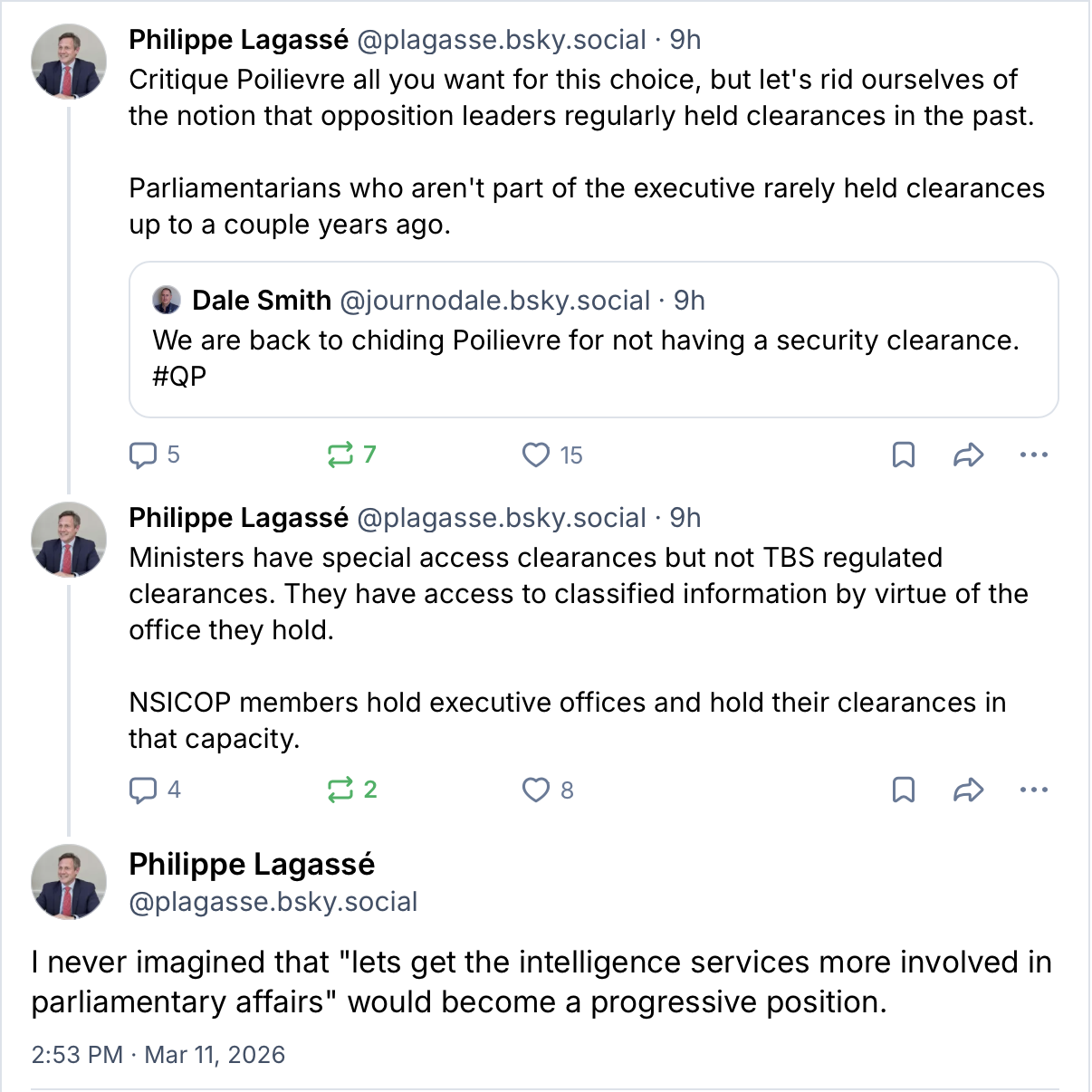
There were a bunch of people in my social media replies claiming nonsense like daycare workers needing a clearance when MPs don’t. No. Daycare workers need to undergo background checks. They don’t need access to classified materials, nor do the vast majority of MPs (though there is a place for a group of MPs to be cleared for certain oversight activities). This conflation of what a clearance actually means is not helpful to anyone, and while I know that people like to claim that Poilievre can’t get one and is therefore some kind of security risk, that is also false and is actually disinformation.
Throughout this, prime minister Mark Carney did not help matters by dodging the questions from reporters on Indian foreign interference and transnational repression by saying that his security clearance precluded him from saying anything. Aside from the fact that this is false, it just provided fuel for Poilievre’s bullshit claims that he would be “muzzled.” The only thing that he would be muzzled about is making wildly irresponsible remarks in order to drum up outrage. Knowledge means being more circumspect in his claims, which he doesn’t want. He wants to say bold, dumb things in the House and in the media, because it gets clicks and attention. Clare Blackwood explained it perfectly here.
Because Poilievre's security clearance is once again back as an applause line in #QP, here is @clareblackwood.bsky.social to accurately explain why Poilievre won't get his.
— Dale Smith (@journodale.bsky.social) 2026-03-11T21:35:30.234Z
Ukraine Dispatch
A Russian drone strike hit a civilian business in Kharkiv, killing two. Ukrainian military trainers will start preparing Germany to defend against Russian attacks by 2029, reversing the trend of western militaries training Ukraine’s.